
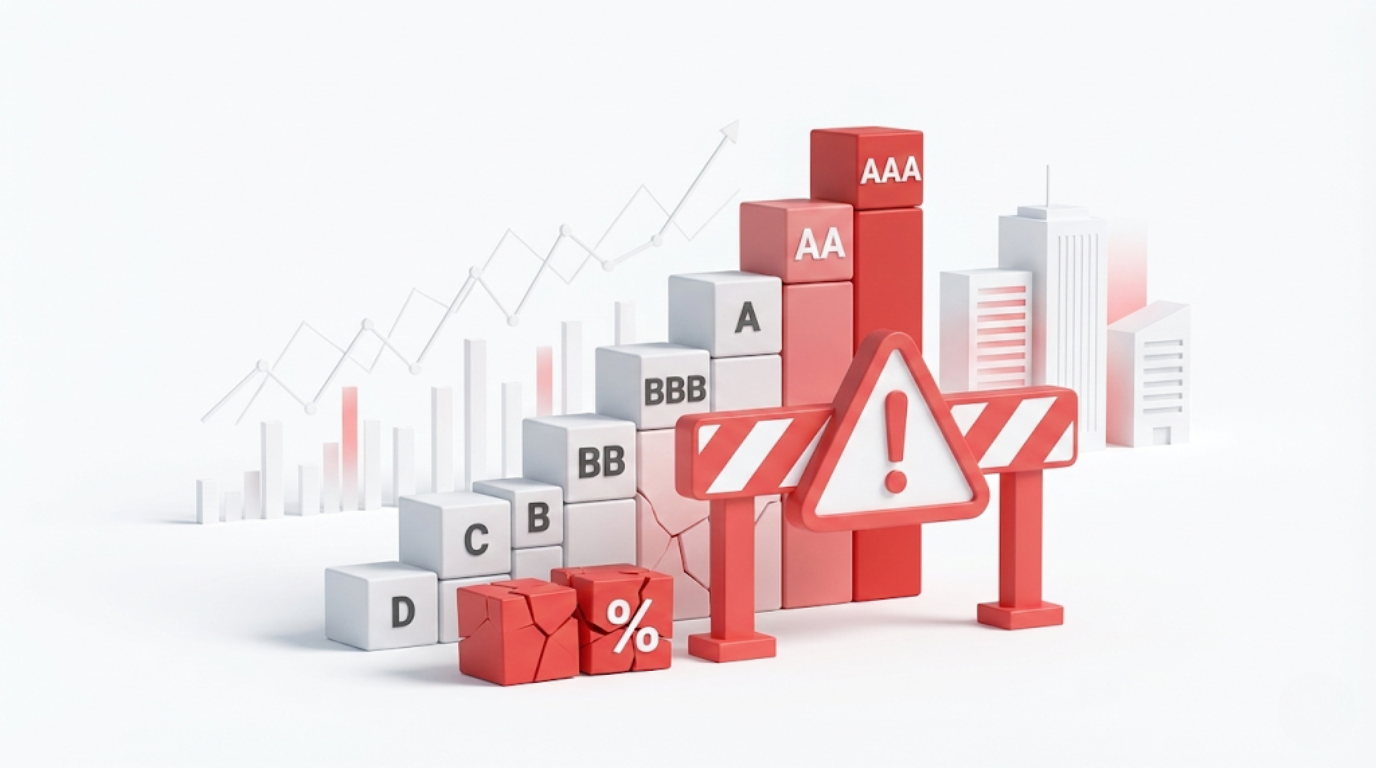
In the world of corporate finance, few outcomes are as sought after as a credit rating upgrade. A higher rating can unlock lower borrowing costs, expand access to capital markets, enhance investor confidence, and strengthen a company’s overall financial credibility.
Against this backdrop, the phrase “guaranteed rating upgrade” often finds its way into boardroom discussions, promoter expectations, and sometimes even advisory conversations.
However, the truth is clear and unequivocal:
There is no such thing as a guaranteed credit rating upgrade.
This belief is not just incorrect—it can be strategically dangerous.
Understanding What a Credit Rating Really Represents
A credit rating is an independent, forward-looking opinion on an entity’s ability to meet its financial obligations in full and on time. It is not a reward, a certification, or a fixed score.
Rating agencies assess credit risk, not business success. Even a profitable, fast-growing company can face rating pressure if its leverage, cash flows, governance, or industry risk profile deteriorates.
Most importantly, credit ratings are:
- Probabilistic, not deterministic
- Dynamic, not static
- Opinion-based, not contractual
A rating reflects how risk looks today and over the foreseeable future, based on available information and assumptions. Since both business conditions and external environments evolve continuously, ratings must also remain fluid.
Why “Guaranteed” Upgrades Cannot Exist
1. Rating Agencies Are Independent by Design
Credit rating agencies operate under strict regulatory and ethical frameworks. Their credibility depends entirely on independence and objectivity.
If an agency were to guarantee an upgrade in advance, it would:
- Compromise its independence
- Undermine investor trust
- Violate regulatory expectations
- Destroy the credibility of its own ratings
For this reason alone, no legitimate rating agency will ever assure a future rating outcome.
2. Rating Methodologies Are Multi-Dimensional and Judgment-Driven
Credit rating methodologies are far more complex than a checklist or formula. They typically evaluate:
- Business risk profile
- Industry characteristics and cyclicality
- Revenue visibility and diversification
- Operating efficiency and margins
- Capital structure and leverage
- Debt protection metrics
- Liquidity and cash flow adequacy
- Management quality and governance
- Financial policies and risk appetite
- Macroeconomic and regulatory environment
Many of these factors involve qualitative judgment, scenario analysis, and forward-looking assumptions.
Since no one can predict future market cycles, regulatory shifts, or economic disruptions with certainty, outcomes can never be guaranteed.
3. External Factors Are Often Beyond Management Control
Even if a company executes perfectly internally, ratings can still be influenced by factors such as:
- Industry downturns
- Regulatory changes
- Interest rate cycles
- Commodity price volatility
- Currency movements
- Macroeconomic slowdowns
- Geopolitical developments
These variables can alter risk perceptions despite strong company-level performance. A guarantee would ignore these realities.
4. Rating Decisions Are Committee-Based
Ratings are not decided by a single analyst. They are the outcome of rating committee deliberations, where multiple professionals review data, assumptions, peer comparisons, and stress scenarios.
Committee structures exist precisely to prevent bias, influence, or pre-commitments. This makes advance guarantees not only impractical but structurally impossible.
The Real Drivers Behind Rating Upgrades
Understanding what actually leads to rating improvement helps dismantle the myth of guarantees.
Sustained Financial Strength
One-time improvements rarely move ratings. Agencies look for consistency:
- Stable and improving cash flows
- Predictable earnings
- Comfortable debt service coverage
- Conservative financial policies
Improved Capital Structure
Meaningful deleveraging, prudent borrowing, and better equity support often carry more weight than short-term profitability spikes.
Business Risk Improvement
Diversification of revenue streams, reduction in customer concentration, stronger market positioning, and scalability improve risk perception.
Liquidity and Cash Flow Visibility
Adequate liquidity buffers, disciplined working capital management, and clarity on cash flow sustainability are critical.
Governance and Management Quality
Strong governance, transparency, succession planning, and risk management frameworks materially influence ratings—especially over the medium term.
Alignment with Industry and Macro Conditions
Even strong companies are evaluated relative to peers and sectoral conditions. Ratings are always contextual.
Why the Promise of “Guaranteed Upgrades” Is Risky
Believing in guaranteed upgrades can lead to flawed strategic decisions, including:
- Over-leveraging in anticipation of a higher rating
- Aggressive capital expenditure without cash flow support
- Mispricing of risk in borrowing decisions
- Underestimating industry or macro headwinds
- Complacency in governance and disclosure practices
When expected upgrades do not materialize, companies often face:
- Market disappointment
- Higher refinancing risk
- Loss of credibility with lenders and investors
- Internal misalignment and blame cycles
Ironically, companies chasing guarantees often weaken their credit profile instead of strengthening it.
The Role of Advisors: Enable, Not Assure
A credible credit rating advisor does not promise outcomes. Instead, the advisor’s role is to:
- Diagnose gaps between current performance and rating expectations
- Align financials and disclosures with rating methodologies
- Strengthen representation of qualitative business strengths
- Prepare management for rating agency interactions
- Improve internal systems, policies, and documentation
- Support consistency and discipline over time
Advisors can improve the probability of a favorable rating outcome—but probability is not certainty.
What Companies Should Focus On Instead
Rather than seeking guarantees, companies should adopt a long-term credit mindset:
- Treat ratings as a continuous process, not a one-time exercise
- Build resilience, not optics
- Prioritize cash flow sustainability over headline growth
- Maintain conservative financial policies across cycles
- Communicate transparently and consistently
- Understand that rating improvement is earned, not promised
Conclusion: Replace the Myth with Maturity
The myth of guaranteed rating upgrades persists because of pressure—for lower costs, faster access to capital, and immediate validation. But credit ratings are not designed to offer certainty; they are designed to reflect risk.
The strongest companies are not those chasing guarantees, but those committed to fundamental credit discipline, transparent governance, and long-term financial sustainability.
In credit ratings, as in finance itself, there are no shortcuts—only structures, strategy, and sustained performance.
