


Why “Unrated” Doesn’t Mean “Bad Credit”
By: admin
Articles
Why “Unrated” Doesn’t Mean “Bad Credit”
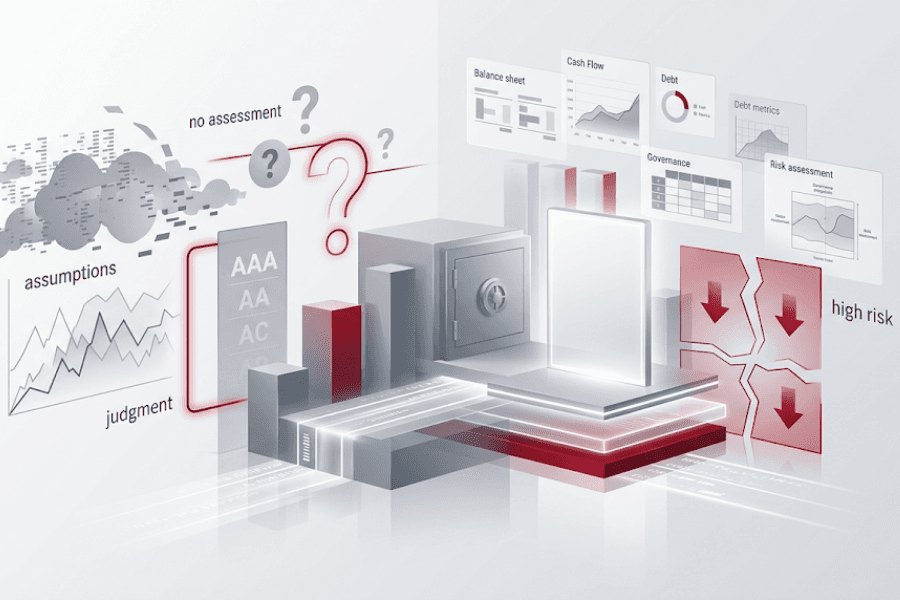
In credit discussions, the word “unrated” often carries an unintended stigma. Many borrowers, lenders, and even investors assume that if a company or debt instrument is unrated, it must be risky, weak, or unsuitable for funding. This assumption, however, is largely misplaced.
Unrated does not mean bad credit.
It simply means that a formal, external credit opinion has not been assigned.
Understanding this distinction is essential—especially in markets where funding decisions, risk perception, and credibility play a critical role.
What Does “Unrated” Actually Mean?
A credit rating is an independent opinion issued by a recognised credit rating agency after analysing an entity’s financial performance, business risk, cash flows, governance, and debt-servicing capacity. These opinions are expressed through rating symbols such as AAA, AA, or BBB.
When an entity is unrated, it means no such formal opinion exists.
Importantly, this status reflects absence of assessment, not assessment of weakness. It does not indicate default risk, poor financials, or weak governance by itself.
Common Reasons Companies Remain Unrated
There are several legitimate reasons why financially sound companies or instruments remain unrated.
1. No Regulatory or Market Requirement
Many companies raise funds through private placements, bank loans, or relationship-based financing where an external rating is not mandatory. In such cases, lenders rely on their own internal credit appraisal systems.
2. Cost vs Benefit Considerations
Obtaining and maintaining a credit rating involves professional fees, documentation effort, and ongoing surveillance. For smaller issuers or companies with limited borrowing needs, the cost may outweigh the immediate benefit—even if credit quality is strong.
3. Early-Stage or Growing Businesses
Newer companies, subsidiaries, or recently restructured entities may not yet have sufficient operating history for a rating agency to form a stable opinion, despite having sound business models and cash flows.
4. Strategic Choice
Some promoters deliberately postpone ratings until:
Expansion plans are executed
Financials stabilise
Capital structure is optimised
This is often done to avoid an early or conservative rating that may not reflect the company’s medium-term strength.
Unrated vs Poorly Rated: A Critical Distinction
A poor credit rating reflects a negative opinion based on assessed risk.
An unrated status reflects no opinion at all.
This distinction matters.
A company with weak fundamentals that is rated will reflect that weakness explicitly. An unrated company, however, may simply not have gone through the formal evaluation process.
Treating both as equivalent leads to flawed conclusions.
Why Unrated Does Not Automatically Mean Higher Risk
Risk is determined by fundamentals, not labels.
Many unrated entities exhibit:
Stable operating cash flows
Conservative leverage
Strong promoter support
Long-standing banking relationships
Asset-backed or secured debt structures
In fact, some unrated instruments offer higher yields not because the credit is inferior, but because investors price in the absence of a standardised third-party opinion.
This “information premium” is not the same as “credit weakness.”
How Lenders and Investors Evaluate Unrated Credit
When a rating is unavailable, sophisticated lenders and investors rely on alternative frameworks, such as:
Detailed financial statement analysis
Cash flow adequacy and debt-service coverage
Security, collateral, and covenant structure
Industry position and competitive dynamics
Management quality and governance practices
In many cases, these internal evaluations are as rigorous as external ratings—and sometimes more tailored to the specific credit risk.
When Unrated Status May Require Deeper Scrutiny
While unrated does not mean weak by default, it does warrant greater diligence in certain situations:
Lack of financial transparency
Inconsistent or limited disclosures
Complex group structures without clarity
Frequent changes in numbers or assumptions
In such cases, the concern is not the absence of a rating, but the absence of reliable information.
Why the “Unrated = Bad Credit” Myth Persists
This misconception persists because:
Ratings are often used as a shortcut for risk assessment
Regulatory frameworks sometimes favour rated exposures
Market participants equate “no rating” with “hidden risk”
However, these perceptions are driven more by convenience than accuracy.
The Strategic Value of Moving from Unrated to Rated
While being unrated is not negative, obtaining a credit rating at the right time can be transformative.
A well-timed rating can:
Improve lender and investor confidence
Reduce borrowing costs
Expand funding options
Enhance market credibility and transparency
The key is readiness—ensuring that the rating reflects true business strength rather than temporary gaps or inefficiencies.
Conclusion
In credit markets, labels matter—but understanding what they truly represent matters more.
Unrated does not mean bad credit.
It means that a formal external opinion has not yet been assigned.
For lenders and investors, the focus should remain on fundamentals, transparency, and risk structures. For borrowers, the decision to remain unrated or seek a rating should be strategic—not reactive.
Informed decisions come not from assumptions, but from understanding the difference between absence of opinion and negative opinion.