


Rating vs Ranking – What’s the Difference?
By: admin
Articles
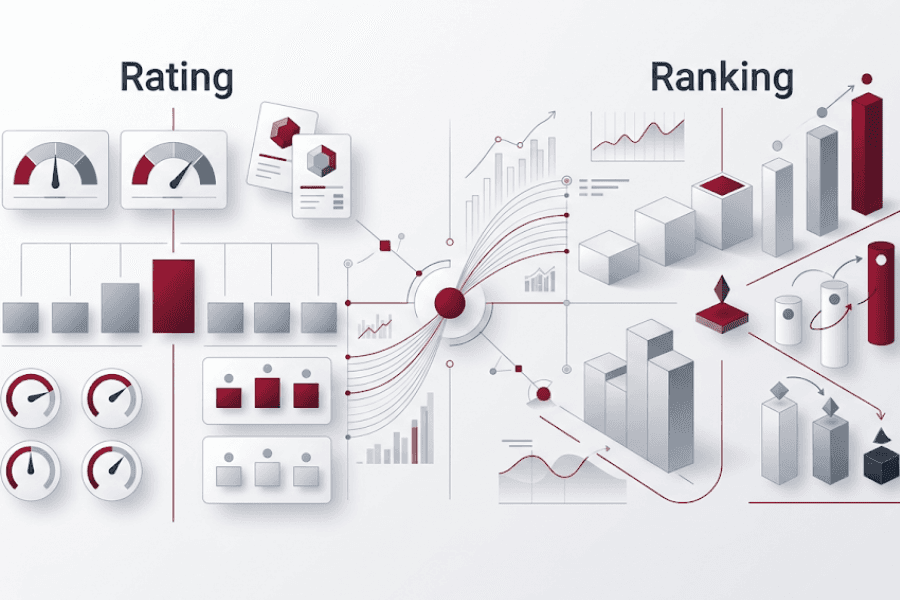
Rating vs Ranking – What’s the Difference?
The terms rating and ranking are often used interchangeably—across business media, education, finance, and even internal performance reviews. While they may sound similar, they serve very different purposes and convey very different meanings. Confusing the two can lead to misinterpretation, flawed comparisons, and poor decision-making.
Understanding the difference between rating and ranking is especially important in contexts where credibility, benchmarking, and perception matter—such as credit assessments, institutional evaluations, product comparisons, and strategic positioning.
This article breaks down the distinction in a simple, practical way.
What Is a Rating?
A rating is an absolute assessment of an entity, product, or performance against a defined scale or criteria. It evaluates how strong, how good, or how risky something is—independently, without reference to others.
Key Characteristics of a Rating
Based on predefined parameters or benchmarks
Expressed through a score, grade, or category
Does not depend on how others perform
Can be assigned to multiple entities at the same level
Examples of Ratings
A credit rating such as AAA, AA, BBB
A product receiving 4.5 out of 5 stars
A service quality score of 85/100
A rating answers the question:
“How strong or good is this, on its own?”
What Is a Ranking?
A ranking is a relative placement of entities in comparison to one another. It arranges items in order—from best to worst or highest to lowest—within a defined group.
Key Characteristics of a Ranking
Always comparative
Depends on the performance of others
Changes when peers enter, exit, or improve
Only one entity can hold each position
Examples of Rankings
A company ranked #3 in its industry
A university ranked #15 globally
A product ranked #1 best seller
A ranking answers the question:
“Where does this stand compared to others?”
The Core Difference: Absolute vs Relative
This is the most important distinction.
Ratings are absolute.
They evaluate performance against a scale or criteria.Rankings are relative.
They position performance against peers.
Simple Illustration
A company can have:
A high rating (strong fundamentals), and yet
A lower ranking (many peers performing equally well or better)
Likewise, an entity may rank high in a small or weak peer group while still having a moderate rating.
Why Ratings and Rankings Are Not Interchangeable
Using one in place of the other can be misleading.
A High Rating Does Not Guarantee a Top Ranking
If many entities meet strong standards, several may receive similar high ratings—but rankings will still differentiate them numerically.
A Top Ranking Does Not Always Mean Superior Quality
An entity could rank high due to limited competition, favourable timing, or narrow criteria—without necessarily achieving a high absolute score.
Ratings vs Rankings Across Common Contexts
1. Credit Assessment
Rating: Reflects creditworthiness based on financial strength, cash flows, business risk, and governance.
Ranking: Compares entities within a sector or peer group.
A borrower may have a strong rating but rank lower simply because the sector has several large, established players.
2. Products and Consumer Reviews
Rating: Indicates customer satisfaction or quality perception.
Ranking: Shows relative popularity or sales position.
A niche product may be highly rated but not ranked at the top in volume-driven lists.
3. Education and Institutions
Ratings: Measure performance across dimensions such as teaching, infrastructure, or outcomes.
Rankings: Place institutions relative to others using weighted criteria.
Both provide insight, but they communicate different messages.
4. Surveys and Decision Research
Rating scales: Allow respondents to score multiple items equally.
Ranking questions: Force prioritisation and comparison.
Each serves a distinct analytical purpose.
Stability vs Volatility
Another important difference lies in how frequently they change.
Ratings tend to be more stable, as they depend on defined criteria and performance thresholds.
Rankings are more volatile, as they shift whenever peers improve, decline, or new participants enter.
This is why rankings fluctuate more often, even when underlying performance remains unchanged.
Why This Distinction Matters for Businesses
1. Strategic Communication
Misrepresenting a rating as a ranking—or vice versa—can distort perception and damage credibility.
2. Decision-Making
Investors, lenders, and stakeholders interpret ratings and rankings differently. Using the wrong metric can lead to flawed conclusions.
3. Benchmarking
Rankings help understand market position.
Ratings help understand intrinsic strength.
Both are useful—but for different reasons.
How Ratings and Rankings Complement Each Other
Rather than choosing one over the other, the most meaningful insights come from using both together.
Ratings explain quality and strength
Rankings explain competitive position
When aligned, they offer a powerful narrative:
Strong fundamentals, validated by position among peers.
Quick Comparison Summary
Aspect | Rating | Ranking |
Nature | Absolute | Relative |
Focus | Quality or strength | Position among peers |
Dependence on others | No | Yes |
Stability | Relatively stable | More dynamic |
Typical output | Grade, score, category | Position or order |
Conclusion
Although often used interchangeably, ratings and rankings answer very different questions.
Ratings tell you how strong something is on its own.
Rankings tell you where it stands compared to others.
Understanding this distinction helps leaders, analysts, and stakeholders interpret information accurately, communicate responsibly, and make better decisions—especially in high-stakes areas like finance, education, and strategic evaluation.
In a world increasingly driven by comparisons and metrics, knowing what is being measured—and how—matters more than ever.