


Public Rating vs Private Credit Evaluation
By: admin
Articles
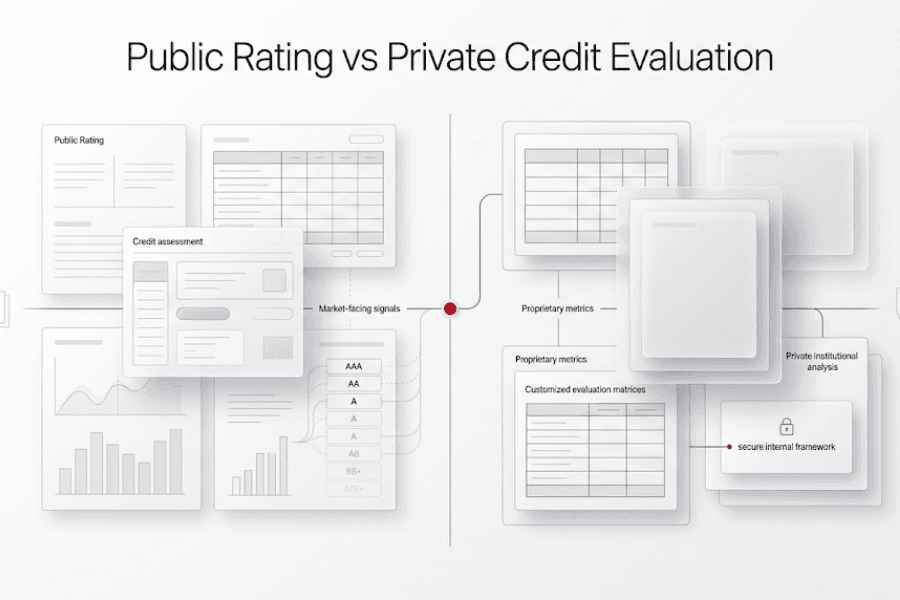
Public Rating vs Private Credit Evaluation
In the financial world, businesses are often assessed through multiple forms of credit analysis.
Two of the most important mechanisms are:
public credit ratings,
and:private credit evaluation.
At first glance, both may appear similar because they involve:
financial analysis,
risk assessment,
repayment capability evaluation,
and creditworthiness assessment.
However, despite these similarities, public ratings and private credit evaluations differ significantly in:
purpose,
transparency,
analytical framework,
stakeholders,
disclosure requirements,
and strategic implications.
Many businesses misunderstand these distinctions.
Some assume that:
a strong private lender assessment automatically guarantees a strong public rating.
Others believe:
a good public rating should automatically ensure unrestricted private funding access.
In reality, these systems operate differently because they are designed for different institutional and market objectives.
Understanding the distinction is increasingly important because modern financing ecosystems now include:
banks,
NBFCs,
private credit funds,
institutional investors,
bond markets,
alternative lenders,
and structured finance participants.
Each may rely differently on:
public ratings,
private evaluations,
or a combination of both.
For promoters, CFOs, and finance teams, understanding how these systems differ helps in:
managing financing expectations,
structuring capital strategy,
improving financial positioning,
and communicating more effectively with stakeholders.
Most importantly, it helps businesses recognize that:
public perception of credit quality,
and:institution-specific lending comfort
are related but not identical concepts.
What Is a Public Credit Rating?
A public credit rating is:
an external opinion issued by a recognized credit rating agency regarding the creditworthiness of a borrower or debt instrument.
It is generally:
published publicly,
accessible to market participants,
and intended for broad financial use.
The rating reflects the agency’s view regarding:
the borrower’s ability to meet financial obligations on time.
Public ratings are commonly used for:
bank borrowings,
bonds,
debentures,
commercial papers,
structured finance instruments,
and institutional lending programs.
These ratings are usually expressed through:
standardized symbols such as:
AAA,
AA,
A,
BBB,
and lower categories depending on the applicable scale.
Public ratings typically include:
rating rationale,
strengths and risks,
outlook,
and analytical commentary.
Their purpose is to provide:
transparency,
comparability,
and independent market-oriented credit assessment.
What Is Private Credit Evaluation?
Private credit evaluation refers to:
institution-specific credit assessment conducted privately by lenders, investors, private credit funds, NBFCs, family offices, or financial institutions.
Unlike public ratings:
these evaluations are usually confidential,
customized,
and not disclosed publicly.
Private credit evaluation helps lenders determine:
whether they are comfortable funding the borrower,
how much exposure to take,
what pricing to charge,
and what protections to seek.
Private evaluations may incorporate:
proprietary risk models,
relationship considerations,
collateral structures,
industry expertise,
behavioural analysis,
and transaction-specific factors.
These assessments are often highly tailored to:
the lender’s own risk appetite,
investment philosophy,
and strategic objectives.
Public Ratings Are Designed for Broad Market Use
One of the biggest differences lies in intended audience.
Public ratings are designed for:
broad market participants including:
banks,
investors,
regulators,
mutual funds,
institutions,
and capital market participants.
They provide:
standardized external risk opinions that can be understood across the financial ecosystem.
Private credit evaluations, however, are designed only for:
the evaluating institution itself.
Their objective is not market transparency.
Instead, they support:
internal lending,
investment,
or risk management decisions.
Thus:
public ratings serve market-wide analytical purposes,
while:private evaluations serve institution-specific decision-making purposes.
Public Ratings Emphasize Comparability
Public credit ratings operate on:
standardized rating scales and methodologies.
This creates:
relative comparability between borrowers.
For example:
companies within similar rating categories are expected to demonstrate broadly comparable levels of credit quality under the agency’s framework.
Private credit evaluations do not necessarily seek comparability across the market.
Each lender may:
apply different models,
prioritize different risks,
use different assumptions,
and maintain different exposure preferences.
As a result:
one private lender may approve funding aggressively,
while:another may remain highly conservative toward the same borrower.
This variability is far more common in private evaluations than in public ratings.
Public Ratings Focus on Long-Term Creditworthiness
Public ratings generally emphasize:
long-term repayment sustainability,
financial resilience,
liquidity stability,
and ability to withstand business cycles.
Rating agencies evaluate:
structural financial strength,
governance quality,
industry risk,
operational resilience,
and long-term debt servicing capability.
Private credit evaluation may sometimes focus more heavily on:
transaction-specific risk,
collateral protection,
short-term repayment visibility,
or investment return expectations.
Therefore:
public ratings often take a broader long-term perspective,
while:private evaluations may be more transaction-oriented.
Transparency Is a Major Difference
Public ratings are:
publicly disclosed,
monitored continuously,
and accompanied by published rationale.
This transparency helps:
investors,
lenders,
and market participants evaluate risk consistently.
Private credit evaluations are generally:
confidential,
proprietary,
and undisclosed.
Borrowers may not receive:
full analytical details,
scoring models,
or internal committee reasoning.
This confidentiality allows private lenders to:
preserve competitive advantage,
protect proprietary models,
and maintain flexibility in risk decisions.
Private Credit Evaluations Often Incorporate Commercial Flexibility
Private lenders may incorporate:
strategic relationship value,
deal structure,
sponsor backing,
collateral support,
co-investment opportunities,
or negotiated protections into their analysis.
Public ratings, however, aim to maintain:
analytical consistency,
methodology discipline,
and independent assessment standards.
As a result:
private lenders may sometimes support transactions that public rating frameworks view more cautiously.
This is particularly common in:
structured transactions,
special situations,
stressed assets,
or opportunistic financing.
Collateral Plays a Different Role
Public ratings generally focus more on:
repayment capability,
cash flow sustainability,
and long-term financial strength.
Although security structures may influence instrument ratings in some cases, agencies still prioritize:
the borrower’s ability to service obligations sustainably.
Private credit evaluations often place much stronger emphasis on:
collateral quality,
recovery potential,
legal protections,
asset coverage,
and downside protection.
For example:
a lender may finance a company despite operational volatility if:
collateral value provides sufficient recovery comfort.
A public rating agency may remain more cautious if:
underlying liquidity and cash flow strength remain weak.
Public Ratings Influence Market Perception
Public ratings significantly affect:
market reputation,
investor confidence,
financing credibility,
and external perception of financial strength.
A strong public rating may improve:
borrowing cost,
debt market access,
institutional participation,
and refinancing flexibility.
Private credit evaluations usually influence:
only the specific financing relationship involved.
Their impact is generally not:
publicly visible,
or market-wide.
Therefore:
public ratings often carry broader reputational implications.
Public Ratings Are Continuously Monitored
Public ratings are subject to:
ongoing surveillance,
periodic reviews,
and continuous monitoring.
Rating agencies evaluate:
changes in financial performance,
liquidity,
leverage,
governance,
industry conditions,
and operational developments over time.
Private credit evaluations may also involve ongoing monitoring, but:
review intensity,
frequency,
and methodology vary widely depending on:
the lender,
exposure type,
and transaction structure.
Some private evaluations may become:
highly dynamic and relationship-driven.
Regulatory Importance Is Greater for Public Ratings
Public ratings often carry:
regulatory significance.
They may influence:
institutional investment eligibility,
capital market participation,
regulatory capital treatment,
investment mandates,
and financing structures.
Many institutions can only invest in:
instruments above certain rating thresholds.
Private credit evaluations are generally:
internal institutional tools rather than regulatory benchmarks.
Thus:
public ratings play a larger systemic role in financial markets.
Public Ratings Aim for Stability
Rating agencies generally attempt to avoid:
excessive rating volatility.
Ratings are typically changed when:
credit fundamentals materially improve or weaken.
Private credit evaluations may react more quickly to:
short-term developments,
operational disruptions,
sector stress,
or transaction-level concerns.
Private lenders often possess:
greater flexibility in adjusting exposure behaviour dynamically.
Private Credit Evaluation Can Be More Flexible
Private lenders may structure:
customized financing solutions,
covenant protections,
collateral packages,
cash flow controls,
or hybrid funding arrangements.
This flexibility allows private evaluation frameworks to:
accommodate unique transaction structures.
Public ratings generally follow:
standardized analytical frameworks designed for broader consistency.
Therefore:
public ratings may appear more conservative in unconventional or highly customized situations.
Businesses Often Need Both
In modern financing ecosystems, many businesses interact with:
both public rating systems,
and:private credit evaluation frameworks simultaneously.
For example:
a company may maintain public ratings for:
bonds,
bank facilities,
or commercial papers,
while also:
negotiating private structured funding arrangements separately.
Strong businesses therefore manage:
market-facing credit perception,
and:institution-specific lender comfort simultaneously.
Divergence Between Public and Private Views Is Common
There are situations where:
public ratings remain stable,
while:private lenders become cautious due to:
sector concerns,
transaction risks,
or internal portfolio strategy.
Similarly:
private lenders may remain supportive because:
collateral protection is strong,
even when:
public ratings remain conservative due to:
weaker cash flow sustainability or leverage concerns.
Such divergence is normal because:
the analytical objectives are fundamentally different.
Governance and Transparency Matter in Both Systems
Despite differences, both public and private evaluations place significant importance on:
governance quality,
transparency,
liquidity discipline,
financial reporting,
and management credibility.
Businesses that:
communicate transparently,
maintain financial discipline,
preserve liquidity,
and demonstrate operational consistency
generally strengthen:
both public rating perception,
and:private lender confidence over time.
Strategic Importance for Businesses
Understanding the distinction between:
public ratings,
and:private credit evaluation
helps businesses:
structure financing more effectively,
manage expectations realistically,
improve communication with stakeholders,
and align funding strategy appropriately.
Companies should recognize that:
strong public ratings improve:
market credibility,
financing access,
and investor perception,
while:
strong private evaluations improve:
institution-specific funding flexibility,
transaction execution,
and lender support.
Both are strategically important but operate differently.
Conclusion
Public credit ratings and private credit evaluations are both critical components of modern financial risk assessment, yet they differ fundamentally in:
purpose,
transparency,
methodology,
flexibility,
and institutional application.
Public ratings provide:
independent,
standardized,
market-oriented opinions regarding long-term credit quality and repayment sustainability.
Private credit evaluations provide:
institution-specific,
confidential,
and customized assessments designed to support lending or investment decisions.
Public ratings emphasize:
comparability,
market confidence,
transparency,
and long-term financial resilience.
Private evaluations often focus more heavily on:
transaction structure,
collateral,
strategic flexibility,
and institution-specific risk comfort.
Businesses that understand these distinctions can:
navigate financing discussions more strategically,
align capital planning more effectively,
and build stronger relationships across both:
public markets,
and private funding ecosystems.
Ultimately, sustainable financial strength remains the common foundation that supports confidence in both:
public credit perception,
and:private institutional evaluation over the long term.