


Rating Upgrade vs Outlook Revision: What Actually Changes?
By: admin
Articles
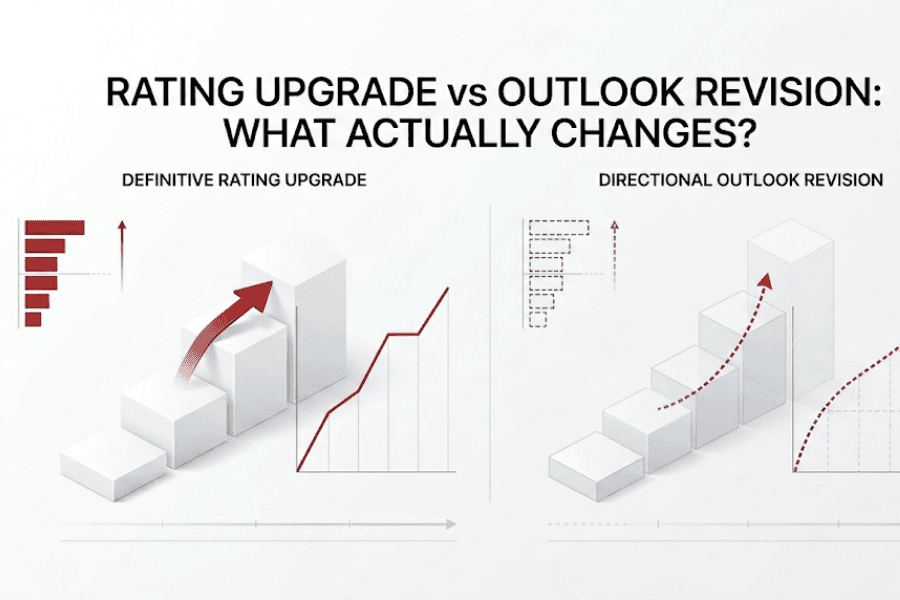
Rating Upgrade vs Outlook Revision: What Actually Changes?
In the world of credit ratings, businesses often hear terms such as:
rating upgrade,
positive outlook,
negative outlook,
outlook revision,
rating watch,
or reaffirmation.
Among these, two developments frequently create confusion:
a rating upgrade,
and:an outlook revision.
Many promoters and finance teams assume that:
a positive outlook automatically means the rating has improved,
or:an outlook revision carries the same impact as an actual upgrade.
In reality, these are very different analytical developments.
Although both reflect changing credit perceptions, they differ significantly in:
meaning,
analytical implication,
market interpretation,
timing,
and practical impact on financing and risk perception.
Understanding this distinction is extremely important because:
businesses often misinterpret outlook revisions as final achievements,
while:lenders and investors continue to differentiate clearly between:
actual rating category changes,
and:directional analytical signals.
A company may receive:
a positive outlook without any rating upgrade,
or:a rating upgrade without a prior prolonged positive outlook in certain situations.
Similarly:
a negative outlook does not automatically mean an immediate downgrade,
though it may indicate rising concerns.
Therefore, businesses should understand:
what exactly changes during an outlook revision,
what changes during a rating upgrade,
and why rating agencies treat these developments differently.
Most importantly, companies should recognize that:
outlook revisions are generally signals about possible future direction,
while:rating upgrades represent actual changes in the agency’s assessment of credit quality.
Understanding the Structure of a Credit Rating
Before understanding the difference, it is important to recognize that a credit rating typically consists of two separate components:
the rating itself,
and:the outlook attached to the rating.
For example:
a company may be rated:
“A Stable”
“A Positive”
“BBB Negative”
In such cases:
the rating category is:
A or BBB,
while:
Stable, Positive, or Negative represent the outlook.
These two elements serve different purposes.
The:
rating category reflects the agency’s current assessment of credit quality.
The:
outlook reflects the possible future direction of the rating over the medium term.
This distinction is central to understanding the difference between:
upgrades,
and:outlook revisions.
What Is a Rating Upgrade?
A rating upgrade occurs when:
the actual rating category improves.
For example:
BBB may become BBB+,
A may become A+,
or AA may become AA+.
This means the rating agency has concluded that:
the company’s credit profile has strengthened sufficiently to justify a higher category of credit quality.
A rating upgrade reflects:
stronger repayment capability,
improved financial resilience,
enhanced liquidity,
reduced risk profile,
or stronger operational stability compared to earlier assessment.
Importantly:
the upgrade changes the company’s formal position within the rating scale.
This often has direct implications for:
borrowing cost,
financing access,
investor perception,
and lender confidence.
What Is an Outlook Revision?
An outlook revision occurs when:
the outlook attached to the rating changes,
while:the rating category itself remains unchanged.
For example:
“A Stable” may become:
“A Positive”
or:
“BBB Stable” may become:
“BBB Negative”
In such cases:
the actual rating level remains unchanged.
The outlook revision simply signals that:
the future direction of the rating may be changing.
A Positive outlook generally indicates:
the possibility of future upgrade if improvements sustain.
A Negative outlook indicates:
increased risk of downgrade if pressures continue.
A Stable outlook indicates:
the rating is expected to remain unchanged in the near to medium term.
Thus:
outlook revisions are directional signals,
not:actual rating changes.
A Rating Upgrade Reflects Current Strength; Outlook Reflects Future Possibility
One of the simplest ways to understand the difference is this:
A rating upgrade means:
the agency believes the company’s credit profile has already improved sufficiently.
An outlook revision means:
the agency sees potential directional change, but additional confirmation may still be required.
Therefore:
upgrades reflect current analytical conclusion,
while:outlook revisions reflect evolving analytical expectation.
This distinction is extremely important.
Rating Upgrades Have Stronger Market Impact
A rating upgrade usually carries:
greater market significance,
stronger lender response,
and wider financing implications.
This is because:
the company’s official rating category improves.
An upgrade may influence:
borrowing spreads,
investor eligibility,
institutional participation,
refinancing flexibility,
and capital market perception.
For example:
certain investors or institutions may only lend or invest above specific rating thresholds.
Therefore:
moving from one rating category to another can materially affect financing opportunities.
An outlook revision, however, may not immediately change:
financing terms,
pricing,
or eligibility.
It primarily serves as:
an analytical signal regarding future direction.
Outlook Revisions Often Precede Rating Actions
In many cases:
outlook revisions act as early indicators before actual upgrades or downgrades.
For example:
a company demonstrating sustained improvement may first receive:
Positive outlook,
before eventually receiving:rating upgrade.
Similarly:
weakening liquidity or rising leverage may first result in:
Negative outlook,
before a possible downgrade later if stress persists.
Thus:
outlook revisions often provide advance analytical guidance regarding evolving credit trends.
However:
outlook revisions do not guarantee future rating action.
Agencies may revise outlooks again if conditions change.
Why Agencies Use Outlooks Instead of Immediate Upgrades
Rating agencies generally prefer:
analytical stability,
gradual assessment,
and confirmation of sustainability.
This is why agencies may avoid immediate upgrades even when:
performance improves materially.
Instead, they may first revise the outlook to Positive while evaluating:
whether improvements are:
sustainable,
consistent,
and structurally durable.
For example:
one year of stronger profitability may not immediately justify an upgrade if:
leverage remains elevated,
liquidity is still evolving,
or industry conditions remain uncertain.
The Positive outlook allows agencies to communicate:
improving direction,
while:waiting for additional confirmation before changing the rating itself.
Outlook Revisions Reflect Evolving Confidence Levels
Outlooks often indicate:
how confident the agency feels regarding future direction.
A Positive outlook suggests:
improving confidence in strengthening credit quality.
A Negative outlook suggests:
rising concern regarding deterioration risk.
However:
the agency may still require additional evidence before taking actual rating action.
Thus:
outlooks act as analytical transition indicators.
They reflect:
evolving risk perception,
rather than:finalized rating conclusions.
Rating Upgrades Usually Require Demonstrated Sustainability
One of the key differences is the degree of evidence required.
A rating upgrade generally requires:
demonstrated,
measurable,
and sustainable improvement.
Agencies usually expect evidence of:
sustained profitability,
improved liquidity,
reduced leverage,
stronger cash flow stability,
operational consistency,
and better financial resilience.
Outlook revisions may occur earlier based on:
improving trends,
strengthening indicators,
or directional momentum.
Thus:
outlook revisions often recognize improving trajectory,
while:upgrades recognize established improvement.
Downgrade Risk vs Negative Outlook
Many businesses panic when they receive:
Negative outlook.
However:
Negative outlook does not automatically mean downgrade.
It simply means:
the probability of downgrade has increased if weaknesses continue.
Agencies may maintain:
Negative outlook for extended periods while monitoring:
liquidity,
leverage,
refinancing,
or sector developments.
If conditions stabilize or improve:
the outlook may return to Stable without downgrade.
Thus:
outlook revisions provide analytical caution,
not necessarily immediate rating action.
Upgrades Usually Require Broader Analytical Improvement
A rating upgrade often requires:
improvement across multiple analytical areas.
These may include:
liquidity,
leverage,
profitability,
governance,
operational scale,
debt servicing capability,
and financial flexibility.
An outlook revision may occur even if:
some improvement areas remain under observation.
Therefore:
agencies use outlooks when:
direction improves,
but:complete analytical comfort has not yet been achieved.
Market Interpretation of Upgrades vs Outlooks
Financial markets typically interpret:
upgrades,
and:outlook revisions differently.
A rating upgrade is viewed as:
a confirmed strengthening of credit quality.
A Positive outlook is viewed as:
potential future improvement.
Similarly:
a downgrade reflects confirmed weakening,
while:Negative outlook signals rising concern.
Thus:
outlooks are viewed more as:
directional indicators,
while:
upgrades and downgrades are viewed as:
finalized analytical actions.
Financing Impact May Differ Significantly
A rating upgrade may lead to:
lower borrowing costs,
wider lender participation,
improved refinancing terms,
and stronger investor interest.
An outlook revision alone may not immediately create:
major pricing benefits,
especially if:the rating category itself remains unchanged.
However:
Positive outlook can still improve:
market sentiment,
lender confidence,
and future financing discussions.
Similarly:
Negative outlook may cause:
increased lender caution,
closer monitoring,
or more conservative funding discussions even before downgrade occurs.
Outlook Stability Matters Over Time
Frequent outlook changes may indicate:
evolving uncertainty,
business volatility,
or inconsistent financial performance.
Companies that maintain:
long-term Stable outlooks often demonstrate:
stronger operational consistency,
better liquidity management,
and healthier financial discipline.
Thus:
outlook stability itself carries analytical significance.
Agencies Avoid Frequent Rating Volatility
Rating agencies generally try to avoid:
excessive rating movement.
Frequent upgrades and downgrades may:
reduce rating credibility,
create market instability,
and weaken analytical consistency.
Therefore:
outlook revisions provide agencies with:
flexibility to communicate evolving risk without immediate rating changes.
This helps maintain:
rating stability,
while:still reflecting changing credit trends.
Businesses Often Misunderstand Positive Outlooks
Many companies celebrate:
Positive outlook as if the upgrade has already occurred.
However:
Positive outlook is not guaranteed upgrade.
If:
industry conditions weaken,
liquidity deteriorates,
leverage rises,
or performance becomes inconsistent,
the outlook may return to Stable without upgrade.
Thus:
businesses should treat Positive outlook as:
an opportunity,
not:a final achievement.
The focus should remain on:
sustaining improvements consistently.
Strong Communication Matters During Outlook Revisions
When outlooks change, agencies usually monitor:
management execution closely.
Businesses should communicate proactively regarding:
liquidity management,
operational performance,
leverage reduction,
refinancing plans,
and strategic developments.
Strong transparency improves:
analytical confidence,
and increases probability of sustainable rating outcomes.
Long-Term Sustainability Drives Both
Ultimately, both:
rating upgrades,
and:outlook revisions
are driven by:
long-term sustainability of credit quality.
Agencies evaluate whether:
improvements are temporary,
or:structurally sustainable across business cycles.
The stronger and more sustainable the company’s:
liquidity,
cash flow,
leverage profile,
governance,
and operational resilience,
the greater the likelihood of:
stronger outlooks,
and eventual rating upgrades.
Conclusion
Although often confused, rating upgrades and outlook revisions are fundamentally different analytical actions.
A rating upgrade reflects:
an actual improvement in the company’s formal credit rating category based on demonstrated strengthening of credit quality.
An outlook revision reflects:
a directional signal regarding possible future rating movement while the rating category itself remains unchanged.
Upgrades represent:
confirmed analytical conclusions.
Outlook revisions represent:
evolving analytical expectations.
Positive outlooks indicate:
potential strengthening.
Negative outlooks indicate:
rising concerns.
However:
outlook revisions do not guarantee future rating action.
Understanding this distinction helps businesses:
interpret rating developments more accurately,
manage financing expectations better,
and focus on sustaining long-term financial improvement rather than short-term perception changes.
Ultimately, the most important objective is not merely achieving:
Positive outlook,
or:temporary rating movement.
It is building:
durable financial strength,
liquidity resilience,
operational consistency,
and governance quality capable of sustaining strong credit quality across changing business and economic cycles.