


How to Prevent a Rating Suspension or Withdrawal
By: admin
Articles
How to Prevent a Rating Suspension or Withdrawal
A credit rating is not a one-time certification. It is a continuously monitored opinion that reflects a company’s evolving credit profile, governance standards, and transparency. While downgrades often receive the most attention, a rating suspension or withdrawal can be equally disruptive — sometimes even more damaging — because it creates uncertainty rather than clarity.
For lenders, investors, and counterparties, the absence of a rating raises immediate concerns. For the company, it can restrict access to funding, increase borrowing costs, trigger covenant breaches, and weaken market credibility. Importantly, most rating suspensions or withdrawals are preventable.
This article explains why ratings get suspended or withdrawn and outlines practical steps companies can take to avoid such outcomes.
What Does a Rating Suspension or Withdrawal Mean?
A rating suspension occurs when a rating agency temporarily halts its opinion because it does not have sufficient, reliable, or current information to maintain an informed view of credit risk. Suspensions are usually reversible once the required information is provided.
A rating withdrawal, on the other hand, is more serious. It indicates that the agency has discontinued coverage because it can no longer responsibly maintain a rating — often due to prolonged non-cooperation, lack of information, or structural changes in the entity or instrument. Re-entering the rating process after a withdrawal typically requires a fresh rating exercise.
Why Do Ratings Get Suspended or Withdrawn?
Understanding the triggers is the first step toward prevention.
1. Inadequate or Delayed Information
Rating agencies depend on timely financial statements, operational updates, and management inputs. Delays in audited results, missing interim data, or incomplete disclosures weaken the analytical foundation of a rating.
2. Non-Cooperation by the Issuer
Failure to respond to queries, reluctance to share information, or disengagement from the surveillance process signals governance concerns. Persistent non-cooperation is one of the most common reasons for withdrawals.
3. Weak Governance and Internal Controls
Inconsistent data, frequent revisions, or unclear accountability within the organisation can erode confidence in the reliability of disclosures.
4. Major Structural or Strategic Changes
Mergers, demergers, restructurings, promoter changes, or business model shifts — if not clearly communicated — can leave agencies unable to assess the issuer’s future credit profile.
5. Cessation or Repayment of Rated Obligations
In some cases, ratings are withdrawn when the underlying debt is fully repaid or the rated instrument ceases to exist. While this is procedural, poor communication can still create confusion in the market.
How Companies Can Prevent Rating Suspension or Withdrawal
Preventing a suspension or withdrawal requires discipline, planning, and proactive engagement. The following practices form a strong defensive framework.
1. Prioritise Timely and Transparent Disclosures
Financial transparency is the foundation of rating continuity.
Companies should ensure:
Audited financial statements are shared promptly.
Interim financials and operational updates are provided on schedule.
Variances, one-off events, and extraordinary items are clearly explained.
Forward-looking information, such as budgets and projections, is consistent and credible.
Even temporary delays should be proactively communicated rather than left unexplained.
2. Maintain Active Engagement With Rating Analysts
Ratings are sustained through ongoing dialogue, not one-time meetings.
Best practices include:
Regular interactions with assigned analysts.
Prompt responses to data requests and clarifications.
Management discussions when material developments occur.
Open explanations during periods of stress or transition.
Consistent engagement reassures agencies that management remains accountable and transparent.
3. Align Internal Systems With Surveillance Requirements
Many companies underestimate the operational effort required for rating surveillance.
To avoid disruptions:
Maintain an internal calendar tracking rating reviews and information submissions.
Assign clear responsibility for rating-related coordination.
Ensure finance, operations, legal, and strategy teams are aligned on disclosures.
Ratings suffer not due to weak performance alone, but often due to poor internal coordination.
4. Avoid Any Perception of Non-Cooperation
Non-cooperation is a serious red flag for rating agencies.
Companies should:
Honour surveillance agreements and timelines.
Address fee-related or administrative issues promptly.
Communicate openly if certain information cannot be shared, along with valid reasons.
Silence or selective disclosure creates uncertainty — and uncertainty undermines ratings.
5. Strengthen Governance and Information Quality
Beyond numbers, agencies assess the quality of governance.
Strong practices include:
Reliable internal reporting systems.
Consistent data across presentations, lenders, and agencies.
Robust audit and compliance frameworks.
Clear decision-making and escalation mechanisms.
Good governance builds analytical confidence, even during challenging periods.
6. Use Early Warning Indicators
Proactive companies track their own risk signals before agencies flag them.
These may include:
Rising leverage or declining coverage ratios.
Liquidity stress or covenant headroom erosion.
Delays in receivables or pressure on cash flows.
Sharing concerns early, along with mitigation plans, is far better than reacting after surveillance stress intensifies.
7. Prepare Agencies in Advance for Strategic Changes
Whether planning an acquisition, restructuring, or major capital expenditure, early communication is critical.
Companies should:
Brief agencies ahead of major announcements where possible.
Share rationale, funding structure, and expected impact on credit metrics.
Update agencies as plans evolve.
Surprises increase risk perception; preparedness builds trust.
If a Suspension Occurs: Act Quickly
If a rating is suspended:
Engage immediately with the agency.
Provide all pending information without delay.
Clarify timelines and corrective actions.
Most suspensions are reversible — but only if addressed promptly. Prolonged inaction significantly increases the risk of withdrawal.
Conclusion: Rating Continuity Is a Management Responsibility
A credit rating is a reflection not just of financial strength, but of discipline, transparency, and governance quality. Preventing a rating suspension or withdrawal requires continuous effort — not only during strong periods, but especially during times of stress.
Companies that treat rating surveillance as an integral part of financial management, rather than a compliance burden, are far more likely to preserve market confidence and funding flexibility.
In today’s environment, rating continuity is not automatic — it is earned through consistent engagement and credible communication.
The Concept of “Rating Watch Negative” Explained
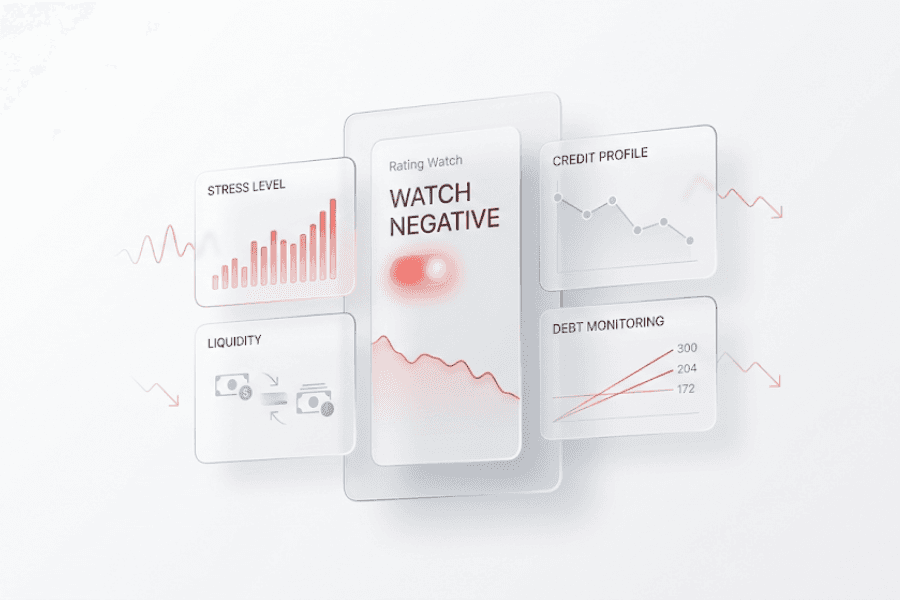
In the world of credit ratings, changes are not always abrupt or absolute. Before a formal downgrade occurs, rating agencies often use intermediate signals to communicate evolving risk. One of the most important of these signals is the “Rating Watch Negative.” This designation is a crucial early warning for companies, investors, and lenders, highlighting potential deterioration in creditworthiness before a formal rating change is made.
Understanding Rating Watch Negative, why it is used, and how it differs from other rating signals is essential for anyone involved in corporate debt, structured finance, or investment decisions.
What Is a Rating Watch?
A Rating Watch is an alert issued by a credit rating agency indicating a heightened probability of a rating change in the near term, based on specific events or developments. It is a short-term, event-driven indicator, used when the full implications on creditworthiness are not yet clear, but there is enough cause for concern or optimism.
Rating Watch categories include:
Rating Watch Positive – signaling a potential upgrade
Rating Watch Developing/Neutral – direction of change is uncertain
Rating Watch Negative – indicating a potential downgrade
Among these, Rating Watch Negative is the most critical because it signals a possible weakening of credit quality.
What Does “Rating Watch Negative” Mean?
When a rating is placed on Negative Watch, it indicates that the rating agency has identified potential adverse developments that could lead to a downgrade in the short term. Key points to understand:
A downgrade has not yet occurred.
Analysts have observed triggers that could weaken the company’s ability to meet its obligations.
It serves as an early warning signal, giving stakeholders time to assess risk before a formal rating action.
Essentially, Rating Watch Negative is a credit risk alert — a sign that creditworthiness may be under pressure and a downgrade is more likely unless corrective measures are taken.
Common Reasons for Negative Watch
Rating agencies typically place a rating on Negative Watch when one or more of the following occur:
Deteriorating Financial Performance – weakening profitability, shrinking cash flows, or declining margins.
Rising Leverage or Weak Liquidity – higher debt levels, weaker coverage ratios, or liquidity stress.
Pending or Unresolved Corporate Events – litigation, regulatory investigations, or pending restructurings.
Macroeconomic or Industry Stress – adverse industry trends or economic slowdown.
Strategic Actions With Unclear Impact – acquisitions, ownership changes, or refinancing that temporarily increase risk.
These triggers suggest that a downgrade is possible unless management takes action to mitigate risk.
Rating Watch Negative vs. Negative Outlook
It’s important to differentiate between Rating Watch Negative and a Negative Outlook:
Rating Watch Negative
Short-term (weeks to months)
Event-driven
Signals a high probability of an imminent downgrade
Negative Outlook
Medium-term (12–24 months)
Trend-driven
Indicates potential credit deterioration over time, not necessarily imminent
Negative Watch is therefore a more urgent signal than a Negative Outlook.
Why Rating Watch Negative Matters
Early Signal to Markets – helps investors and lenders anticipate potential credit deterioration.
Impact on Borrowing Costs – spreads may widen and access to funding may tighten.
Covenant Implications – may trigger covenants in loan agreements tied to credit ratings.
Reputational Impact – affects counterparty confidence, strategic negotiations, and market perception.
It is a clear indicator that the company’s credit profile is under scrutiny.
How Companies Should Respond
A Negative Watch offers an opportunity to prevent a downgrade. Companies can take the following steps:
Reinforce Financial Controls – improve cash flows, tighten cost management, and strengthen liquidity.
Address Underlying Triggers – resolve debt pressures, divest non-core assets, or stabilize operations.
Engage with Rating Agencies – provide clear updates, action plans, and timely information to analysts.
Enhance Transparency – share performance updates, forecasts, and strategic plans to reduce uncertainty.
Proactive responses can help lift the watch status and restore confidence in the company’s creditworthiness.
When Does a Watch Resolve?
A Rating Watch is removed when:
The uncertainty or event triggering the watch is resolved.
The agency receives additional information clarifying credit implications.
The agency decides a downgrade is warranted, and the rating is formally revised.
The agency determines no change is needed and reaffirms the existing rating.
Watch durations are typically short but can extend if the underlying issues remain unclear.
Conclusion
Rating Watch Negative is a critical pre-downgrade signal. It provides early warning to stakeholders and an opportunity for issuers to take corrective action. For companies, it emphasizes the need for proactive engagement, improved transparency, and strategic intervention. For investors, it highlights potential near-term risk in a credit exposure.
Understanding Rating Watch Negative enables companies and stakeholders to manage risk effectively, maintain credibility, and navigate credit challenges with foresight and discipline.