


Documents Companies Often Underestimate During Credit Rating Assessments
By: admin
Articles
Documents Companies Often Underestimate During Credit Rating Assessments
One of the most common misconceptions during a credit rating assignment is the belief that ratings are determined primarily through:
audited financial statements,
turnover,
profitability,
and net worth.
As a result, many companies focus heavily on presenting:
balance sheets,
profit and loss accounts,
and financial ratios,
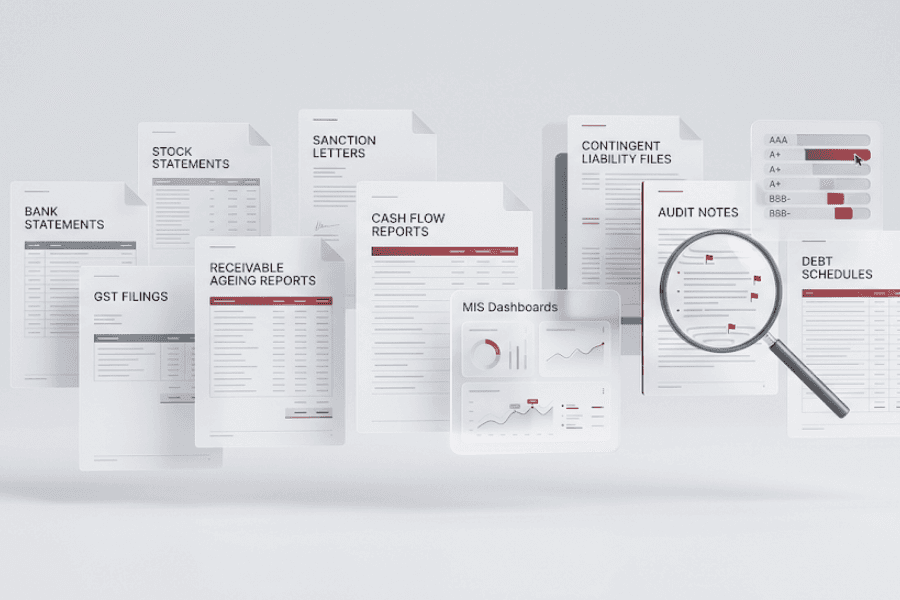
while underestimating the importance of several operational, banking, legal, and management-related documents that significantly influence the overall rating assessment.
In reality, credit rating analysis is far more comprehensive.
Rating agencies evaluate not only:
what the financial statements show,
but also:how sustainable the business is,
how disciplined operations are,
how liquidity behaves in real time,
and how effectively management handles risks.
Many of these insights emerge from supporting documents that companies often consider secondary or routine.
In numerous cases, rating outcomes are materially influenced not by the audited numbers themselves, but by:
inconsistencies in operational data,
weak banking conduct,
stretched receivables,
contingent liabilities,
liquidity stress indicators,
or governance-related disclosures hidden within supporting documents.
Understanding the importance of these underestimated documents helps businesses:
prepare more effectively,
improve analytical confidence,
reduce negative surprises during assessments,
and present a more accurate representation of their credit profile.
Why Supporting Documents Matter So Much in Ratings
Financial statements provide a historical snapshot.
However, rating agencies attempt to assess:
current financial behaviour,
operational stability,
future sustainability,
and repayment capability under varying conditions.
Supporting documents help agencies:
validate financial claims,
assess real-time liquidity,
identify hidden risks,
and understand operational discipline.
For example:
strong profits may appear positive in financial statements,
but:delayed receivables,
excessive stock build-up,
stressed banking utilization,
or contingent liabilities
may indicate emerging financial pressure.
Therefore, agencies rely heavily on supplementary documentation to evaluate the true quality of the financial profile.
Bank Statements and Banking Conduct
One of the most underestimated yet highly important documents in credit rating analysis is the bank statement.
Many companies assume that once audited financials are submitted, bank transactions carry limited importance.
In reality, rating agencies carefully evaluate:
account conduct,
cheque returns,
overdrawings,
frequent ad hoc usage,
and liquidity behaviour reflected in banking operations.
Bank statements provide direct insight into:
cash flow discipline,
operational liquidity,
repayment behaviour,
and financial stress indicators.
Agencies often identify concerns such as:
continuous near-full limit utilization,
frequent balance shortages,
delayed servicing,
or irregular transaction patterns.
Even companies reporting accounting profitability may display liquidity stress through banking conduct.
Healthy banking discipline significantly improves lender confidence.
Stock Statements
For businesses using working capital facilities, stock statements become extremely important.
Companies often view them merely as routine bank compliance documents.
However, rating agencies use stock statements to assess:
inventory levels,
operational trends,
working capital behaviour,
and consistency with financial reporting.
Inconsistencies between:
stock statements,
audited inventory,
and operational data
can raise concerns regarding:
reporting quality,
inventory management,
or financial transparency.
Agencies also monitor:
inventory build-up,
stock ageing,
and sudden fluctuations in working capital patterns.
Excessive inventory accumulation may indicate:
weak demand,
liquidity blockage,
or operational inefficiency.
Receivable Ageing Reports
Many businesses submit overall debtor figures but underestimate the importance of detailed receivable ageing analysis.
From a rating perspective, receivable quality is often more important than receivable size.
Agencies carefully examine:
ageing buckets,
overdue balances,
concentration risk,
disputed receivables,
and collection efficiency.
Long outstanding receivables may indicate:
customer stress,
weak collection systems,
or liquidity pressure.
Particular concern arises when:
a large portion of receivables remains overdue beyond standard credit periods,
recoverability appears uncertain,
or customer concentration is excessive.
Receivable ageing reports often reveal liquidity realities that may not be immediately visible from financial statements alone.
GST Returns and Tax Filings
GST filings are increasingly becoming important analytical tools during credit rating assessments.
Many companies underestimate their significance because they perceive them as purely compliance-related documents.
However, agencies use GST data to:
validate turnover consistency,
compare operational trends,
assess revenue stability,
and cross-check reported financial information.
Differences between:
GST turnover,
audited revenue,
and operational claims
may trigger analytical concerns.
Regular and timely tax compliance also reflects:
financial discipline,
governance quality,
and operational stability.
Frequent delays, mismatches, or irregular tax filings can negatively affect analytical confidence.
Bank Sanction Letters
Companies often submit sanction letters merely as formal banking documents.
In reality, these letters provide critical information regarding:
facility structure,
repayment terms,
security coverage,
covenants,
and lender observations.
Agencies evaluate:
borrowing dependence,
security structures,
repayment schedules,
and funding flexibility through these documents.
Sanction letters may also reveal:
special conditions,
lender concerns,
restrictive covenants,
or temporary approvals.
Understanding banking arrangements is essential for evaluating liquidity and refinancing risk.
Detailed Debt Repayment Schedules
Many businesses provide total debt figures without submitting detailed repayment schedules.
However, agencies require precise understanding of:
debt maturities,
repayment timing,
and future financial obligations.
Debt repayment schedules help assess:
refinancing dependence,
near-term liquidity pressure,
and cash flow adequacy.
Even financially healthy businesses may face rating pressure if:
debt maturities are heavily concentrated,
repayment obligations exceed expected cash flows,
or refinancing assumptions appear aggressive.
Granular debt schedules are therefore critical to liquidity analysis.
Contingent Liability Details
Contingent liabilities are among the most underestimated risk disclosures during rating assessments.
Companies often assume that because such liabilities are not immediately payable, they carry limited importance.
However, agencies evaluate:
guarantees,
legal claims,
arbitration exposure,
tax disputes,
corporate guarantees,
and off-balance-sheet obligations very carefully.
Large contingent liabilities may create future financial stress if adverse outcomes materialize.
For infrastructure and EPC companies especially, unresolved claims and guarantees can materially affect:
liquidity,
leverage,
and financial flexibility.
Incomplete disclosure of contingent liabilities can significantly weaken analytical confidence.
Related-Party Transaction Details
Related-party transactions are closely scrutinized during rating assessments.
Many companies underestimate the importance of:
intercompany loans,
unsecured advances,
group transactions,
and promoter-linked financial arrangements.
Agencies assess whether such transactions:
weaken liquidity,
increase financial complexity,
or create governance concerns.
Large related-party exposure may indicate:
cash flow diversion,
financial dependency,
or weak operational independence.
Transparent disclosure and proper structuring are therefore essential.
Order Book and Customer Data
For sectors such as:
EPC,
manufacturing,
exports,
engineering,
and project-based businesses,
order book details become highly important.
Agencies evaluate:
revenue visibility,
customer concentration,
execution timelines,
margin sustainability,
and contractual terms.
However, many companies provide only broad summaries rather than detailed order-level information.
Agencies often require:
project status,
completion schedules,
customer profile,
and payment terms.
A large order book alone is insufficient if:
execution capability is weak,
margins are thin,
or collections remain uncertain.
Management Information System (MIS) Reports
Strong MIS reporting reflects operational discipline and governance quality.
Companies often underestimate how much agencies value:
monthly operational tracking,
cash flow monitoring,
inventory reporting,
and internal financial controls.
Well-structured MIS systems indicate:
management awareness,
financial control,
and operational preparedness.
Weak MIS reporting may suggest:
poor monitoring systems,
delayed decision-making,
or governance weaknesses.
The quality of internal reporting often influences confidence in management capability.
Project Reports and Capex Plans
Businesses planning expansion frequently submit optimistic project reports without detailed financial justification.
Agencies evaluate:
funding structure,
project viability,
implementation timelines,
debt assumptions,
and projected returns very carefully.
Weakly prepared project reports may raise concerns regarding:
overestimation of demand,
aggressive projections,
or future leverage pressure.
Detailed and realistic project documentation strengthens analytical credibility.
Auditor Qualifications and Notes to Accounts
Many businesses underestimate the importance of:
audit qualifications,
emphasis of matter paragraphs,
and notes to accounts.
Rating agencies study these sections carefully because they may reveal:
unresolved disputes,
contingent risks,
liquidity concerns,
revenue recognition issues,
or governance-related observations.
Even when headline financial numbers appear strong, negative audit observations can materially weaken rating perception.
Litigation and Legal Documents
Pending litigation is another area companies often downplay.
However, agencies assess:
legal exposure,
financial implications,
operational disruption risks,
and potential liabilities.
Large unresolved disputes involving:
taxation,
contracts,
environmental matters,
or financial claims
can affect future cash flows and liquidity.
Transparent disclosure is critical because hidden legal risks may damage management credibility if discovered later.
Cash Flow Statements and Fund Flow Analysis
Many businesses focus primarily on profitability while underestimating the importance of cash flow statements.
Agencies analyze:
operating cash generation,
fund utilization,
debt-funded growth,
and liquidity sustainability.
Strong profits without corresponding cash generation may indicate:
working capital stress,
weak collections,
or aggressive accounting.
Cash flow quality is often more important than accounting profitability in rating analysis.
Projections and Assumption Notes
Management projections are frequently submitted with:
ambitious growth assumptions,
limited justification,
or inadequate sensitivity analysis.
Agencies evaluate:
realism of assumptions,
linkage with industry conditions,
funding feasibility,
and stress resilience.
Unrealistic projections can weaken management credibility and analytical confidence.
Well-supported projections backed by operational logic are viewed far more favourably.
Insurance Coverage Documents
Insurance details are often overlooked during rating preparation.
However, agencies may evaluate whether:
operational assets,
inventory,
projects,
and key facilities are adequately insured.
Weak insurance coverage increases vulnerability to:
operational disruptions,
financial losses,
and unexpected events.
Adequate risk protection strengthens business resilience perception.
Why Underestimating Documents Can Affect Ratings
Many businesses believe that only:
profitability,
turnover,
and net worth
drive ratings.
However, supporting documents often reveal:
operational discipline,
governance quality,
liquidity stress,
and hidden financial vulnerabilities.
Incomplete or inconsistent documentation may create:
analytical uncertainty,
lower confidence,
and higher perceived risk.
In contrast, transparent and organized documentation significantly improves:
management credibility,
analytical comfort,
and overall rating perception.
The Importance of Transparency During the Rating Process
One of the most important principles in credit rating assignments is transparency.
Rating agencies understand that every business faces:
operational challenges,
temporary stress,
and market uncertainties.
Concerns arise not necessarily from the existence of challenges, but from:
weak disclosure,
inconsistent reporting,
or attempts to conceal risks.
Transparent communication supported by detailed documentation often strengthens confidence even during difficult periods.
Conclusion
Credit rating assessments extend far beyond audited financial statements.
While profitability, leverage, and net worth remain important, agencies rely heavily on supporting documents to evaluate:
liquidity behaviour,
operational discipline,
governance quality,
risk exposure,
and repayment sustainability.
Documents often underestimated by companies — including:
bank statements,
stock statements,
receivable ageing,
GST filings,
sanction letters,
contingent liabilities,
MIS reports,
and cash flow data —
frequently play a decisive role in shaping overall rating perception.
These documents help agencies understand the true operational and financial realities behind headline numbers.
Businesses that approach the rating process with:
transparency,
organized documentation,
accurate disclosures,
and disciplined reporting
generally build stronger analytical confidence and improve the quality of their overall credit assessment.
Ultimately, in credit ratings, supporting documents are not merely administrative formalities.
They are critical indicators of financial discipline, operational stability, and long-term creditworthiness.