


India's Credit Rating Industry Just Got a Major Update, Are You Ready for It?
By: admin
Articles

SEBI's Annual Report 2025–26 just reshaped who can rate what and how. If your business raises capital through instruments regulated by anyone other than SEBI, this changes what "getting rated" now looks like for you. Here's what corporates and CFOs need to know before their next rating exercise.
Every year, SEBI's Annual Report offers a window into how India's capital markets infrastructure is evolving. The 2025–26 edition is particularly telling for anyone connected to the credit rating industry it lays out a set of policy moves that, together, point toward a rating ecosystem being deliberately widened, modernised, and made more transparent.
For business owners and finance leaders, this direction matters. The rules governing how Credit Rating Agencies (CRAs) operate shape how ratings are issued, disclosed, and trusted which in turn affects how a rating is read by lenders and investors. Here's what the report tells us, organised around the key facts.
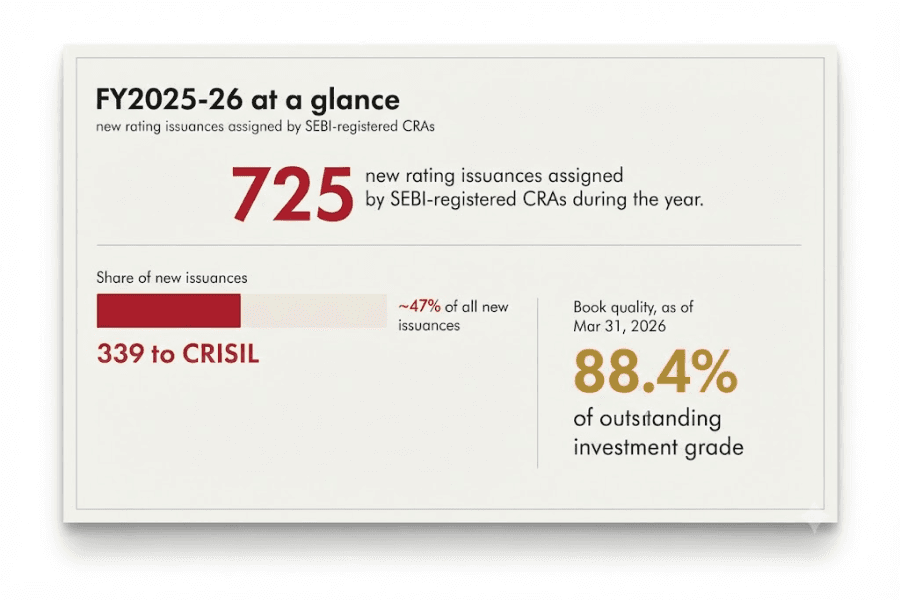
725-New rating issuances assigned by SEBI-registered CRAs
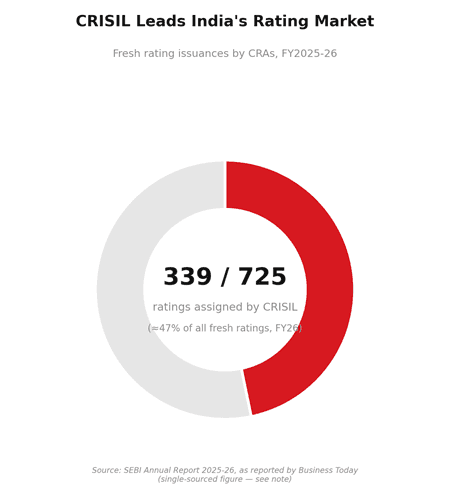
339-of those issuances went to CRISIL alone (~47%)
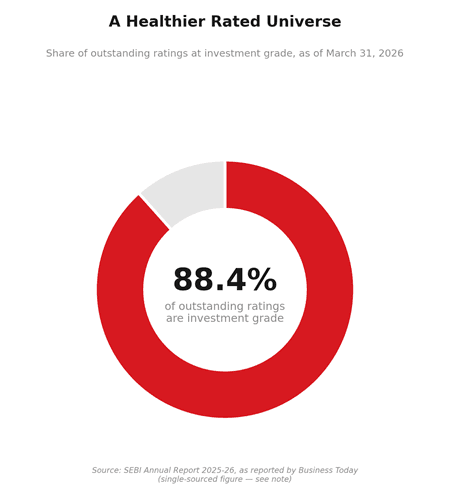
88.4%-of outstanding ratings were investment grade as of Mar 31, 2026
Fact 1: CRAs Can Now Rate Instruments Beyond SEBI's Own Regulatory Reach
The headline change: SEBI has permitted CRAs to take on rating assignments for financial instruments that fall under the jurisdiction of regulators other than SEBI itself. Until now, a CRA's core mandate centred on SEBI,regulated debt instruments. This move meaningfully broadens what a CRA can rate.

Fact 2: The Expansion Comes With Ring,Fencing, Not a Free Hand
SEBI hasn't opened this door without conditions. Three safeguards stand out:
Separate disclosure and grievance infrastructure CRAs handling non,SEBI,regulated assignments must maintain dedicated email addresses and distinct website sections for grievances and disclosures tied to those instruments, kept apart from SEBI,regulated business.
Mandatory regulator labelling every rating report and marketing material for a non,SEBI instrument must clearly name the actual governing regulator and state that SEBI's investor protection framework doesn't apply to it.
Independent net worth compliance CRAs must continue meeting SEBI's minimum net worth norms on a standalone basis, with any additional capital requirements from other regulators met separately.
This structure signals SEBI's intent to let CRAs diversify while keeping the line between SEBI,regulated and non,SEBI,regulated work visible to anyone reading a rating report.

Fact 3: ESG Rating Providers Get More Operational Flexibility
The report also covers ESG Rating Providers (ERPs), who operate under the same 1999 CRA regulations. Subscriber,pays ERPs can now share rating reports with subscribers and issuers simultaneously, rather than circulating a draft to the issuer first. ERPs have also been permitted to rate products and issuers regulated by authorities other than SEBI, subject to disclosing which regulator governs the product.

Fact 4: Municipal Bonds Get a New Rating Lens
SEBI has extended Expected Loss (EL) ratings to municipal bonds. Rather than relying only on the standard probability,of,default scale, CRAs can now assign EL,based ratings that also factor in recovery prospects giving a fuller picture for project,based municipal bond issuances.

Municipal Bond Issuances: A Sharp Rise in FY26
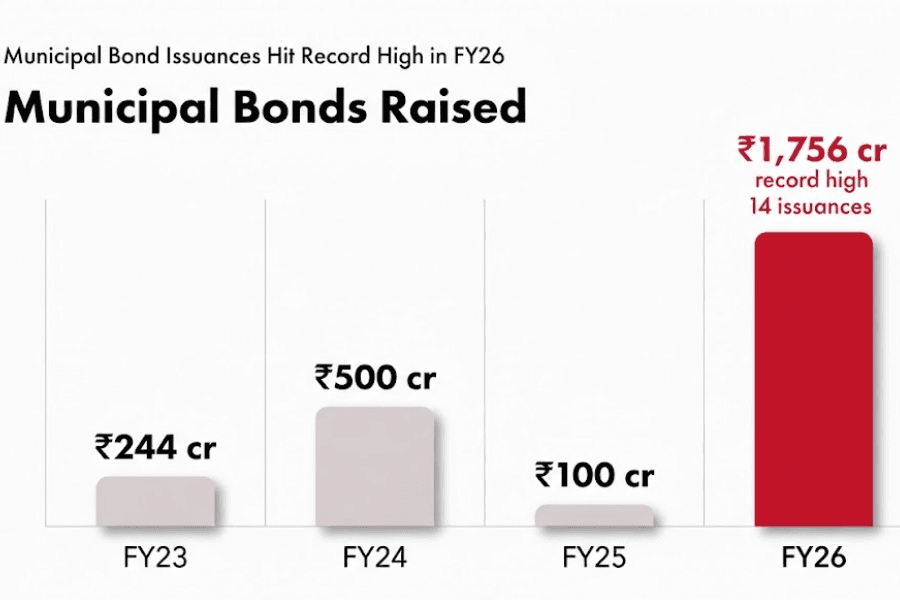
Municipal bond issuances saw a significant increase in FY26, with ₹1,756 crore raised through 14 issuances- a record high. SEBI has credited the increase to targeted municipal-bond awareness outreach.
Here’s how municipal bond issuances progressed:
FY23: ₹244 crore FY24: ₹500 crore FY25: ₹100 crore FY26 (latest): ₹1,756 crore through 14 issuances
This means the amount raised in FY26 was more than 17 times the amount raised in FY25, highlighting the sharp increase in municipal bond activity.
Fact 5: The Rating Industry Is Growing, and Quality Is Improving
The numbers back this up. SEBI,registered CRAs assigned ratings to 725 new issuances during 2025–26, with CRISIL accounting for 339 of those nearly half of all fresh ratings issued. As of March 31, 2026, 88.4% of outstanding ratings were investment grade, an improvement over the prior year, reflecting a generally healthier credit profile across rated entities.

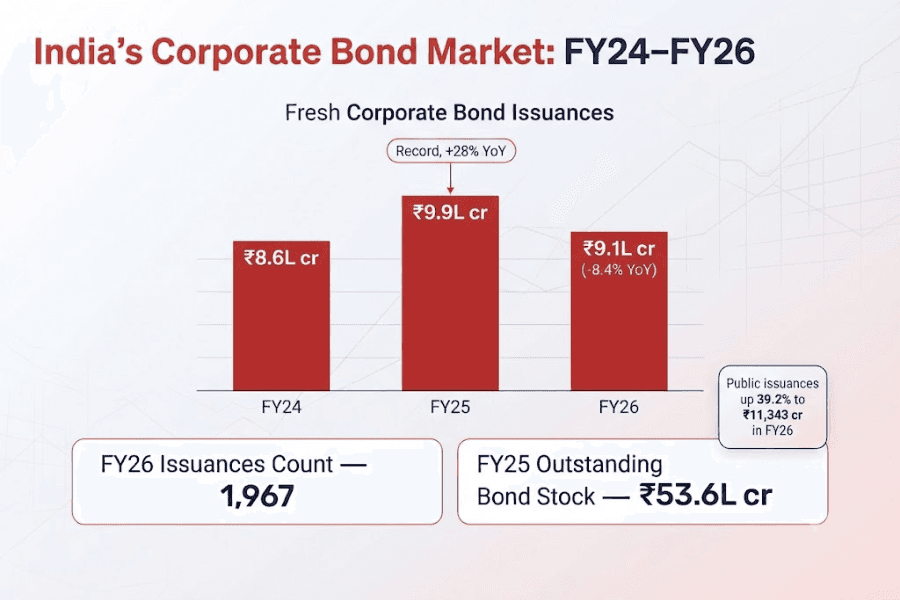
Corporate Bond Market: FY24–FY26
Fresh corporate bond issuances
FY24: ~₹8.6 lakh crore FY25: ₹9.9 lakh crore (record, +28% YoY) FY26: ₹9.1 lakh crore (-8.4% YoY)
Number of corporate bond issuances
FY24: – FY25: – FY26: 1,967
Outstanding corporate bond stock
FY24: – FY25: ₹53.6 lakh crore FY26: –
Why It All Fits Together
None of these changes stand alone. SEBI frames them as part of a broader 2025–26 policy push to make it easier for CRAs to operate, refine how ratings are arrived at, and tighten disclosure standards all aimed at greater transparency, standardisation, and more accurate pricing of credit risk. The common thread across the CRA expansion, the ERP changes, and the municipal bond framework is the same: more instrument types are being brought into a structured rating regime, with disclosure safeguards built in at every step.

What This Means for Corporations in India
For corporations engaging with the credit rating process whether an NBFC, an infrastructure or EPC player, a manufacturer, a real estate developer, or a mid,market company preparing for an IPO these changes carry several practical implications:
More avenues to formalise credit standing on non,traditional instruments. Companies raising capital through instruments regulated by authorities other than SEBI now have a clearer path to getting those instruments formally rated by an established CRA, rather than operating in a less standardised space particularly relevant for sectors like NBFCs and infrastructure financing, where instruments can span multiple regulatory regimes.
A new due diligence checkpoint before engaging a CRA. With CRAs now able to operate across regulatory frameworks, corporations need to confirm upfront which regulator governs the specific instrument being rated, and what disclosure standards apply especially relevant for finance teams presenting a rating to lenders, investors, or boards.
Municipal and infrastructure linked entities gain a more nuanced rating tool. The extension of Expected Loss ratings to municipal bonds is directly relevant to entities involved in urban infrastructure, project financing, and public private structures, where recovery prospects not just default probability matter to how a project is assessed by investors.
ESG,linked corporates get more flexibility in how ratings are shared. Companies working with ESG Rating Providers may see faster turnaround, since subscriber pays ERPs can now share reports with issuers and subscribers simultaneously rather than issuing a draft to the company first.
A generally stronger credit environment to benchmark against. With 88.4% of outstanding ratings at investment grade as of March 2026, corporations preparing for a rating exercise are entering a system where the overall quality bar has been improving useful context when setting expectations for how a company's own credit profile might be assessed relative to peers.

Across sectors NBFC, infrastructure, construction, real estate, manufacturing, EPC, renewable energy, healthcare, textiles, pharma, and MSME businesses alike the common thread is the same: as the rating ecosystem widens and its rules get more specific, companies that enter a rating exercise with a clear understanding of the applicable framework are better positioned to manage the process and present their credit story accurately to lenders and investors.
At FinMen Advisors, we read this year's SEBI Annual Report as a sign that the credit rating industry is being deliberately built out wider in scope, more standardised in disclosure, and increasingly data backed. The combination of a broader CRA mandate, more operational flexibility for ESG Rating Providers, and a new rating lens for municipal bonds suggests SEBI is treating ratings as infrastructure that needs to keep pace with a more diverse set of financial instruments, not just traditional corporate debt.
The improvement in the investment,grade share of outstanding ratings of 88.4% as of March 2026 is also worth noting. It points to a rated universe that is, on the whole, in healthier shape, a positive signal for issuers and investors alike.
Our takeaway for business owners is straightforward: as the scope of what gets rated expands, so does the importance of understanding exactly which regulatory framework, disclosure standard, and rating methodology applies to your specific situation. A rating exercise today looks different depending on the instrument involved, and going in prepared with a clear sense of what will be assessed and how puts a company in a stronger position throughout the process.
For Context: Where India's Own Sovereign Rating Stands
The reforms above concern the CRAs that rate Indian corporates and municipal bodies. It is worth separately tracking the sovereign rating that the three major global agencies assign to India itself, since that benchmark shapes the broader borrowing-cost environment every Indian issuer operates in.
India’s Sovereign Credit Ratings
S&P Global Current Rating: BBB Outlook: Stable Most Recent Action: Reaffirmed on August 27, 2026. Originally upgraded from BBB- in August 2025, marking its first India upgrade in 18 years.
Moody’s Ratings Current Rating: Baa3 Outlook: Stable Most Recent Action: Reaffirmed on July 27, 2026. The rating has remained unchanged since it was cut from Baa2 to Baa3 in June 2020.
Fitch Ratings Current Rating: BBB- Outlook: Stable Most Recent Action: Reaffirmed on August 11, 2026, marking its 20th consecutive year at this level. The rating has remained unchanged since 2006.
The trajectory matters as much as the current notch. Moody's raised India to Baa2 in November 2017, its first upgrade in 14 years at the time, then moved it back to Baa3 in June 2020 during the pandemic, where it has held ever since across multiple affirmations. Fitch has kept India at the lowest investment-grade notch, BBB-, without a change since 2006, now 20 straight years, citing a still-elevated government debt burden. S&P's August 2025 move to BBB, its first India upgrade since 2007, cited fiscal consolidation toward a 4.4% of GDP deficit and sustained growth, and it held that line again in its August 2026 review. Read together, India now sits at the lowest rung of investment grade at two of the three major agencies, with S&P one notch ahead, and all three affirmed their current stance within the last few weeks of each other in mid-to-late 2026.
The Takeaway
SEBI's 2025–26 reforms point to a credit rating industry that's expanding in scope while tightening its disclosure standards from letting CRAs rate instruments beyond SEBI's own jurisdiction, to giving ESG Rating Providers more flexibility, to bringing municipal bonds into a more comprehensive rating framework. For businesses, the practical takeaway is to stay informed about which framework and methodology applies to their specific rating exercise, as the landscape is evolving faster than in previous years.
Understand your rating readiness before you begin the process. Talk to our experts to know where your business stands.