


How Rating Agencies Assess NBFCs Differently from Corporates
By: admin
Articles
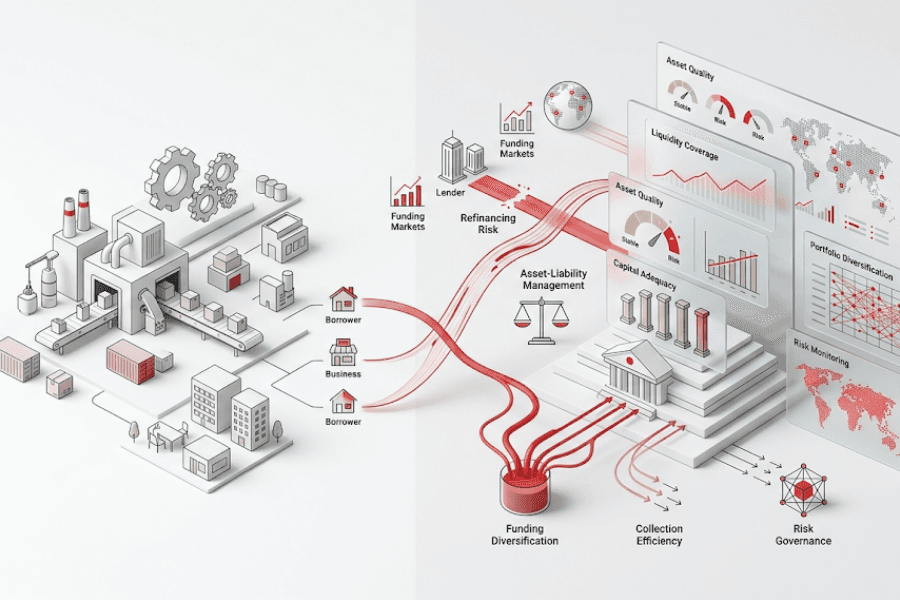
How Rating Agencies Assess NBFCs Differently from Corporates
Non-Banking Financial Companies (NBFCs) occupy a unique and increasingly important position in the financial ecosystem.
Over the years, NBFCs have emerged as major providers of:
retail credit,
MSME financing,
vehicle loans,
housing finance,
infrastructure funding,
gold loans,
microfinance,
and specialized lending solutions.
Although NBFCs operate as businesses similar to corporates in certain respects, the methodology used by credit rating agencies to assess NBFCs is fundamentally different from the framework applied to manufacturing, trading, or service-based companies.
This distinction exists because NBFCs operate in a completely different risk environment.
For most corporates, the primary focus of credit analysis revolves around:
operational performance,
cash flow generation,
profitability,
business sustainability,
and debt servicing capability.
In contrast, NBFCs deal directly with financial intermediation.
Their business model itself revolves around:
borrowing money,
lending money,
managing liquidity,
pricing credit risk,
and maintaining financial stability.
As a result, rating agencies evaluate NBFCs through a much deeper lens focused on:
asset quality,
liquidity resilience,
capitalization,
funding stability,
governance,
and risk management capability.
Two companies may report similar balance sheet sizes or profitability numbers, but an NBFC will still undergo a significantly more specialized and risk-sensitive evaluation process than a typical corporate entity.
Understanding these differences is critical because many businesses entering financial services underestimate how differently the credit ecosystem views NBFCs compared to traditional corporates.
The Fundamental Difference Between NBFCs and Corporates
The most important distinction lies in the nature of business operations.
A typical corporate earns revenue through:
manufacturing products,
providing services,
trading goods,
infrastructure execution,
or operational activities.
Its primary risks usually involve:
market demand,
operational efficiency,
competition,
working capital management,
and industry cycles.
An NBFC, however, operates fundamentally as a financial risk-taking institution.
Its core business involves:
borrowing funds from lenders,
deploying capital into loans and investments,
earning spreads,
and managing repayment risks.
This creates an entirely different risk profile.
Unlike corporates, NBFCs are highly dependent on:
confidence,
liquidity access,
funding stability,
and financial discipline.
Even profitable NBFCs can face stress if:
liquidity weakens,
collections deteriorate,
or refinancing access becomes constrained.
Therefore, rating agencies place significantly greater emphasis on financial resilience and systemic stability while assessing NBFCs.
Asset Quality Becomes a Central Rating Driver
One of the biggest differences in NBFC assessment is the intense focus on asset quality.
For corporates, rating agencies primarily evaluate:
operational cash flows,
profitability,
leverage,
and business sustainability.
For NBFCs, however, the quality of the loan book becomes one of the most important determinants of credit strength.
Agencies carefully examine:
Gross NPA levels,
Net NPA levels,
collection efficiency,
restructuring trends,
write-offs,
borrower quality,
delinquency patterns,
and portfolio seasoning.
This is because an NBFC’s future stability depends heavily on whether borrowers repay loans on time.
A manufacturing company may survive temporary demand weakness if operations remain stable.
But an NBFC facing widespread loan defaults can quickly experience:
profitability erosion,
liquidity stress,
capital pressure,
and funding challenges.
Therefore, asset quality analysis forms the core of NBFC credit assessment.
Liquidity Assessment Is Far More Critical for NBFCs
Liquidity is important for all businesses, but for NBFCs it becomes existential.
Corporates generally generate cash through:
business operations,
sales,
and internal accruals.
NBFCs, however, rely heavily on continuous market confidence and funding availability.
Their ability to:
refinance borrowings,
maintain liquidity buffers,
and access funding markets
is critical for survival.
Rating agencies therefore evaluate:
liquidity coverage,
asset-liability maturity profile,
short-term borrowing dependence,
available cash balances,
unutilized bank lines,
and contingency funding arrangements.
Particular attention is given to:
ALM mismatches,
near-term repayment obligations,
and refinancing concentration risks.
Even a profitable NBFC can face severe pressure if liquidity weakens temporarily.
This is one reason why liquidity analysis for NBFCs is far more detailed and dynamic than for traditional corporates.
Funding Diversification Matters More for NBFCs
A manufacturing company may operate comfortably with:
term loans,
working capital facilities,
and internal accruals.
NBFCs, however, require constant funding support to sustain lending operations.
As a result, agencies carefully assess:
funding diversity,
lender concentration,
capital market access,
securitization capability,
and refinancing flexibility.
An NBFC dependent on:
a limited number of lenders,
short-term borrowings,
or concentrated funding sources
faces elevated refinancing risk.
Agencies prefer NBFCs with diversified funding profiles across:
banks,
mutual funds,
bonds,
securitization markets,
development institutions,
and long-term investors.
Strong funding diversification improves resilience during periods of market stress.
Capital Adequacy Is More Important in NBFC Ratings
For most corporates, leverage and net worth are important financial indicators.
However, NBFCs are assessed more rigorously on capital adequacy because capital acts as the primary buffer against credit losses.
Rating agencies evaluate:
Capital Adequacy Ratio (CAR),
Tier I capital,
net worth adequacy,
gearing levels,
and loss absorption capacity.
A strong capital base provides:
resilience against rising NPAs,
growth flexibility,
lender confidence,
and regulatory comfort.
NBFCs with thin capitalization are viewed more cautiously because unexpected loan losses can quickly weaken financial stability.
Capital adequacy assessment is therefore central to NBFC rating methodologies.
Earnings Quality Is Evaluated Differently
For corporates, profitability is often assessed through:
EBITDA margins,
operating profitability,
and cash flow generation.
For NBFCs, agencies focus more on:
Net Interest Margins (NIMs),
spread stability,
cost of funds,
credit costs,
and return ratios.
Importantly, agencies evaluate the sustainability and quality of earnings rather than merely absolute profitability.
High profitability generated through:
aggressive lending,
risky borrower segments,
or weak underwriting standards
may actually increase future credit risk.
Therefore, rating agencies assess whether profitability is supported by:
prudent risk management,
stable collections,
and disciplined lending practices.
This makes NBFC profitability analysis much more risk-sensitive than corporate profitability evaluation.
Risk Management Framework Is Far More Important
One of the defining features of NBFC assessment is the emphasis on risk management systems.
Unlike traditional corporates, NBFCs deal directly with:
credit risk,
liquidity risk,
interest rate risk,
concentration risk,
operational risk,
and market risk.
Agencies therefore carefully evaluate:
underwriting standards,
credit appraisal systems,
collection mechanisms,
monitoring frameworks,
risk governance structures,
and internal controls.
Weak risk management can rapidly destabilize an NBFC even during periods of growth.
This is why agencies often place enormous importance on:
portfolio monitoring,
collection discipline,
and underwriting quality.
For corporates, operational efficiency may dominate analysis.
For NBFCs, risk management capability becomes equally important as financial performance itself.
Regulatory Oversight Plays a Larger Role
NBFCs operate within a regulated financial ecosystem supervised by the Reserve Bank of India.
As a result, regulatory compliance becomes a major component of rating assessment.
Agencies evaluate:
compliance track record,
adherence to RBI guidelines,
provisioning standards,
governance practices,
and regulatory observations.
Regulatory tightening can materially affect:
growth,
liquidity,
capital requirements,
and profitability.
This makes the regulatory environment far more relevant for NBFCs than for most non-financial corporates.
Any adverse regulatory developments or compliance weaknesses can significantly affect rating perception.
Governance and Promoter Credibility Carry Higher Weight
Governance is important for all companies, but it carries particularly high significance for NBFCs because they handle public and institutional funds.
Agencies carefully assess:
promoter integrity,
board oversight,
transparency,
disclosure quality,
related-party exposure,
and governance standards.
Weak governance can create systemic financial risks in lending businesses.
As a result, rating agencies often adopt a stricter governance lens for NBFCs compared to traditional corporates.
Past events in the financial sector have reinforced the importance of:
transparency,
prudent lending culture,
and responsible management conduct.
Strong governance significantly strengthens lender and investor confidence.
Portfolio Granularity Matters Significantly
For manufacturing companies, customer concentration risk is important.
For NBFCs, borrower diversification becomes even more critical.
Agencies evaluate:
exposure concentration,
borrower profile mix,
geographic diversification,
ticket size distribution,
and sectoral exposure.
NBFCs with highly concentrated borrower bases face elevated risk because defaults by a few large borrowers can materially affect asset quality.
Retail-focused NBFCs with:
diversified borrower pools,
granular loan books,
and broad geographic spread
often demonstrate stronger portfolio resilience.
Portfolio granularity therefore becomes a major differentiating factor.
Economic Sensitivity Is Assessed Differently
Corporates are generally evaluated based on operational cycles and industry conditions.
NBFCs, however, are highly sensitive to:
economic cycles,
interest rate movements,
liquidity conditions,
and borrower repayment behaviour.
Economic downturns can simultaneously impact:
collections,
funding access,
borrower defaults,
and profitability.
Agencies therefore stress-test NBFCs under adverse economic scenarios more aggressively than many corporates.
The ability to withstand macroeconomic shocks becomes a major rating consideration.
Parentage and External Support Often Carry Greater Importance
For many NBFCs, promoter strength and potential external support materially influence ratings.
Agencies evaluate:
group support capability,
parental commitment,
financial flexibility,
and strategic importance within the group.
NBFCs backed by:
strong corporate groups,
banks,
or institutional promoters
often benefit from higher confidence regarding:
liquidity support,
capital infusion,
and refinancing access.
While group support can also matter for corporates, it often plays a more direct and critical role in NBFC ratings because of the sector’s dependence on confidence and funding access.
Market Confidence Becomes a Core Element
One of the most unique aspects of NBFC ratings is the role of market perception.
NBFCs operate in a confidence-driven environment.
Negative sentiment alone can:
reduce funding access,
increase borrowing costs,
trigger liquidity pressure,
and weaken operational stability.
Therefore, rating agencies pay close attention to:
market reputation,
investor confidence,
lender relationships,
and funding behaviour.
This confidence sensitivity is much higher for NBFCs than for most traditional corporates.
Why NBFC Ratings Can Change Faster Than Corporate Ratings
NBFCs often experience quicker rating movements because:
liquidity conditions can change rapidly,
borrower behaviour can deteriorate suddenly,
funding markets may tighten,
and refinancing risks can emerge quickly.
Corporates typically have more stable operational cash flow cycles.
NBFCs, however, remain highly interconnected with broader financial market conditions.
As a result, agencies continuously monitor:
liquidity,
collection efficiency,
asset quality,
and funding access with greater intensity.
This dynamic nature makes NBFC credit assessment more sensitive and continuously evolving.
Conclusion
Credit rating assessment for NBFCs differs fundamentally from traditional corporate evaluation because NBFCs operate as financial risk intermediaries rather than purely operational businesses.
While corporate ratings primarily focus on:
operational performance,
cash generation,
industry strength,
and business sustainability,
NBFC ratings place far greater emphasis on:
asset quality,
liquidity resilience,
funding stability,
capital adequacy,
risk management,
governance,
and regulatory compliance.
NBFCs function within a confidence-driven financial ecosystem where:
liquidity,
collections,
refinancing access,
and market trust
directly influence stability and survival.
As a result, rating agencies adopt a much more risk-sensitive and dynamic analytical framework while assessing NBFCs.
For NBFCs seeking stronger and sustainable ratings, long-term success depends not merely on growth or profitability, but on building:
prudent lending practices,
disciplined risk management,
strong governance,
stable funding structures,
and resilient liquidity frameworks.
Ultimately, in NBFC credit assessment, stability and trust are often more important than rapid expansion alone.