


ESDS Software Rating Upgrade: What Drove the Move to IND A/Stable?
By: admin
News & Insights
ESDS Software Rating Upgrade: What Drove the Move to IND A/Stable?
India Ratings upgrades ESDS Software Solution’s long-term bank facility rating to IND A/Stable
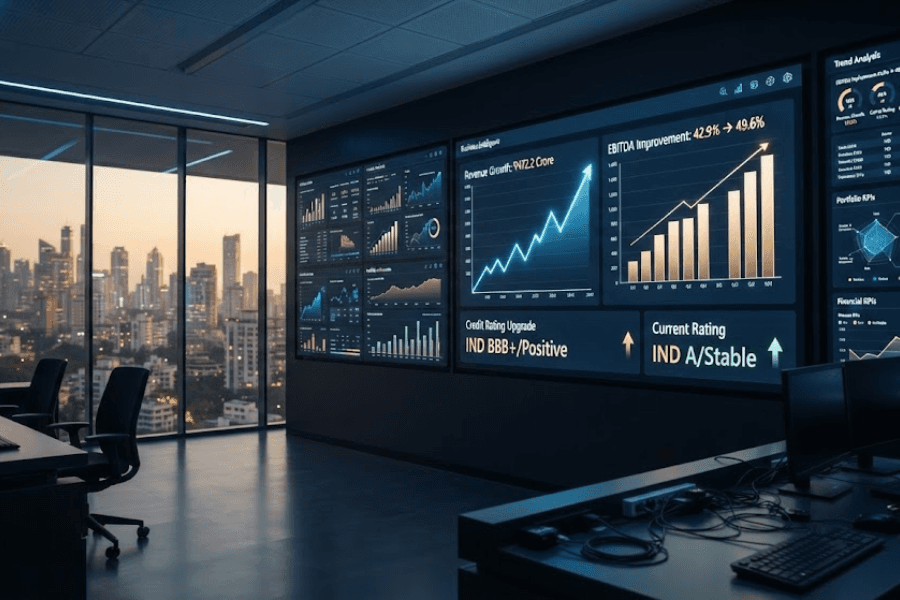
India Ratings and Research (Ind-Ra) has upgraded the long-term rating on ESDS Software Solution Limited’s ₹50 crore bank loan facilities to IND A/Stable, from IND BBB+/Positive. The agency has also upgraded the company’s short-term rating to IND A1 from IND A2+.
The latest rating action highlights how business diversification, recurring revenues, order-book visibility and stronger credit metrics can influence a company’s overall credit profile.
What changed in ESDS Software’s rating?
The upgrade represents a movement from the BBB+ category to the A category for the company’s long-term bank facilities.
Particular
Earlier
Revised
Long-term rating
IND BBB+/Positive
IND A/Stable
Short-term rating
IND A2+
IND A1
Long-term bank facilities
₹50 crore
₹50 crore
The upgrade follows a period of significant business and financial growth for ESDS.
According to the reported rating rationale, Ind-Ra considered the company’s larger and more diversified business profile, growth in recurring cloud and managed-services revenue, improved order-book visibility and stronger credit metrics.
Revenue growth has strengthened the credit profile
ESDS reported consolidated revenue of ₹472.2 crore in FY26, compared with ₹361.3 crore in FY25, representing growth of around 31%.
Consolidated EBITDA increased from ₹154.9 crore to ₹234.2 crore during the same period. The EBITDA margin also increased from 42.9% to 49.6%.
Another significant change has been the increasing contribution from managed services. Managed services accounted for 41% of FY26 revenue, compared with 21% in the previous year.
For a rating assessment, the quality and visibility of revenue can be as important as headline growth. A larger recurring-revenue base can provide greater visibility into future operating cash flows, although the rating agency continues to assess the associated business and execution risks.
Cloud and GPU infrastructure are becoming important growth drivers
ESDS is expanding its business in cloud infrastructure, managed services and AI computing.
The company has entered into an agreement with SharonAI Holdings Inc. relating to the offtake of 8,208 Nvidia B300 GPUs, with a service fee payable of $1.25 billion over five years.
ESDS has also entered into an enterprise customer agreement involving GPU-as-a-Service, cloud and managed services through its SWARAJ Cloud platform.
The GPUaaS project is scheduled for commissioning in Q3 FY27. Ind-Ra expects the order book, capacity expansion and commencement of GPUaaS revenue to support the company's growth in FY27.
This is an important part of the company's evolving business profile, but it also introduces substantial capital requirements.
Capital expenditure remains an important rating consideration
ESDS is developing approximately:
5 MW of IT load capacity in Kolkata
20 MW in Sahibabad
An additional 10 MW expansion in Bengaluru
The company has also earmarked a substantial portion of the ₹720 crore raised through equity for cloud and GPU servers, networking equipment and data-centre infrastructure during FY27 and FY28.
The Kolkata and Sahibabad developments could involve approximately ₹1,000–₹1,100 crore of cumulative capital expenditure, depending on the company's funding decisions and execution timeline.
This creates an important balance for the rating assessment.
Growth can strengthen a credit profile when additional revenue and operating profitability develop alongside expansion. However, significant debt-funded capex without corresponding EBITDA growth can place pressure on leverage and cash flows.
Ind-Ra has specifically indicated that sustained consolidated net leverage above 2.0x, resulting from debt-funded investment without corresponding EBITDA growth, could lead to negative rating action.
Customer concentration remains a watchpoint
Despite the rating upgrade, the company continues to face customer concentration risk.
The top 10 customers accounted for 45.4% of FY26 revenue, although this was lower than 49.3% in FY25.
The agency expects customer concentration could increase after the commencement of GPUaaS operations.
This illustrates an important aspect of credit assessment: a rating upgrade does not mean that all business risks have disappeared.
Rating agencies continue to monitor factors that could affect future cash flows, leverage, profitability and debt-servicing capacity.
What does a Stable Outlook mean?
Along with the upgrade to IND A, Ind-Ra has assigned a Stable Outlook.
A Stable Outlook generally indicates that the agency does not currently expect a material change in the company's rating over the foreseeable period, based on its assessment of the company's expected operating and financial profile.
It should not be interpreted as a guarantee that the rating will remain unchanged. Future rating actions remain dependent on the company's actual performance and developments in the factors considered relevant by the rating agency.
What businesses can learn from the ESDS rating action
The ESDS case highlights several factors that businesses preparing for a credit rating can pay attention to.
1. Revenue growth needs to be supported by business quality
Growth becomes more meaningful from a credit perspective when it is supported by recurring revenue, customer visibility and sustainable operating performance.
2. EBITDA growth matters alongside expansion
A company undertaking significant capex needs to demonstrate that the additional investment can translate into operating cash flows and profitability over time.
3. Customer concentration can remain relevant even during growth
Increasing revenue does not automatically eliminate concentration risk. The dependence on a limited number of customers can continue to influence the assessment of business risk.
4. Funding strategy matters
The source used to finance expansion can have a direct impact on leverage and credit metrics. Equity funding, internal accruals and debt can have different implications for a company's balance sheet.
5. Future plans are assessed alongside current financial performance
Order books, planned capacity additions, new contracts and expansion projects can influence the assessment of future business prospects. At the same time, agencies assess execution capability and the financial requirements associated with those plans.
The larger credit-rating perspective
ESDS Software's move to IND A/Stable from IND BBB+/Positive demonstrates that a rating assessment looks beyond a single financial metric.
The latest action reflects a combination of factors including business diversification, recurring cloud and managed-services revenue, order-book visibility and stronger credit metrics, while capital intensity and customer concentration remain areas of monitoring.
For companies approaching a rating exercise, the key takeaway is that the credit story needs to connect business performance, financial strength, funding strategy, liquidity and future plans into one coherent picture.
A strong operating performance is important, but the sustainability of that performance and its impact on future cash flows and leverage also matter.
Source: ET Telecom, based on information attributed to India Ratings and Research and ESDS Software Solution.
Disclaimer
This article is intended solely for general informational and educational purposes and does not constitute financial, credit, investment, legal, tax, regulatory or professional advice.
Credit ratings are assigned solely by SEBI-registered Credit Rating Agencies based on their own methodologies, policies and information available to them at the time of assessment. FinMen Advisors provides credit rating advisory and preparatory support to companies undergoing a rating exercise and does not issue, influence or guarantee any credit rating outcome.
Readers should independently verify information through official company disclosures, rating agency publications, regulatory filings and other authoritative sources before making any business or financial decisions.