


A Step-by-Step Explanation of the Credit Rating Process
By: admin
Articles
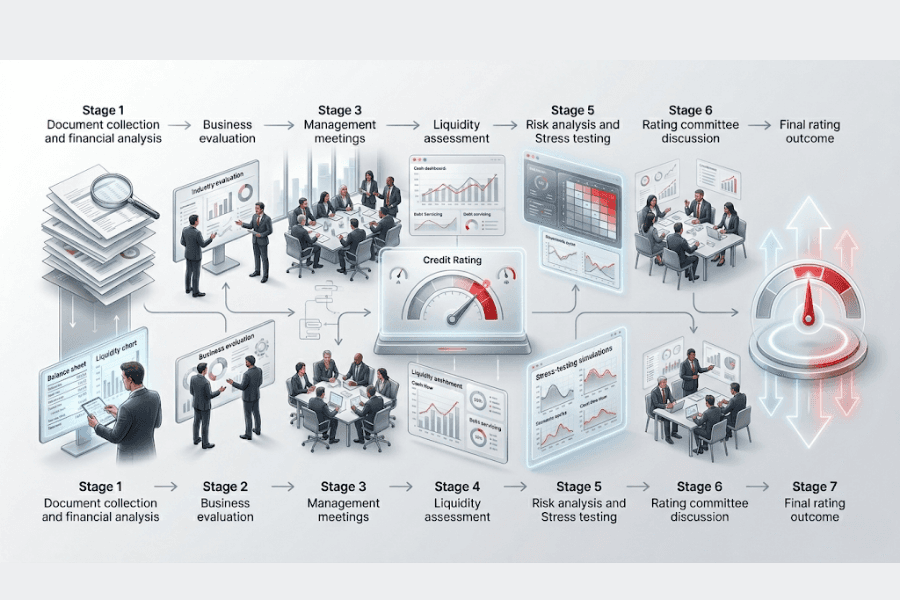
A Step-by-Step Explanation of the Credit Rating Process
Credit ratings play a crucial role in the modern financial ecosystem.
They influence:
lending decisions,
borrowing costs,
investor confidence,
capital market access,
and overall financial credibility.
For businesses, a credit rating is often far more than just a financial grade.
It becomes an external assessment of:
financial strength,
repayment capability,
operational stability,
management quality,
and long-term business sustainability.
Despite its importance, many companies still have limited understanding of how the actual credit rating process works.
Promoters and finance teams often assume that ratings are assigned primarily based on:
balance sheet strength,
turnover,
profitability,
or collateral availability.
In reality, the credit rating process is a highly structured, analytical, and multi-dimensional evaluation framework that combines:
quantitative analysis,
qualitative assessment,
industry evaluation,
management interaction,
risk analysis,
and forward-looking judgement.
The process is designed not only to assess the company’s current financial condition, but also its ability to continue servicing financial obligations across varying business and economic conditions.
Understanding the rating process helps businesses:
prepare better for evaluations,
communicate more effectively with agencies,
improve financial positioning,
and avoid common misunderstandings during assessments.
What Is a Credit Rating?
A credit rating is an independent opinion issued by a credit rating agency regarding the ability and willingness of an entity to meet its financial obligations on time.
It reflects the agency’s assessment of:
credit risk,
financial stability,
liquidity strength,
and repayment reliability.
Ratings may be assigned to:
companies,
banks,
NBFCs,
debt instruments,
structured finance products,
or specific borrowing facilities.
Higher ratings generally indicate:
lower perceived default risk,
stronger financial profile,
and higher repayment confidence.
Lower ratings suggest:
elevated financial risk,
weaker liquidity,
or higher uncertainty regarding repayment capability.
However, a credit rating is not:
a guarantee,
an investment recommendation,
or a prediction of profitability.
It is fundamentally a risk assessment opinion.
Step 1: Initial Engagement and Mandate Acceptance
The rating process usually begins when a company approaches a credit rating agency for:
bank loan ratings,
debt instrument ratings,
working capital assessments,
NCD ratings,
commercial paper ratings,
or other financing-related purposes.
At this stage:
the scope of rating is defined,
facilities to be rated are identified,
and engagement formalities are completed.
The agency typically shares:
information requirements,
documentation lists,
and process timelines.
The company formally accepts the rating mandate and provides authorization for the evaluation process.
This marks the beginning of detailed analytical assessment.
Step 2: Information Collection and Data Submission
One of the most important phases of the rating process is information gathering.
The company is required to submit extensive documentation covering:
financial statements,
operational details,
management information,
banking arrangements,
projections,
and industry-related data.
Commonly required documents include:
audited financial statements,
provisional financials,
bank sanction letters,
stock statements,
GST returns,
management profiles,
debt repayment schedules,
project reports,
and operational data.
Agencies may also request:
customer details,
supplier information,
order book data,
receivable ageing,
contingent liabilities,
and future expansion plans.
The objective is to develop a comprehensive understanding of:
business operations,
financial profile,
liquidity position,
and risk exposure.
Accurate and transparent data submission is extremely important because incomplete or inconsistent information can negatively affect analytical confidence.
Step 3: Business and Industry Analysis
Once information is received, analysts begin detailed business assessment.
This stage focuses on understanding:
the company’s business model,
industry dynamics,
competitive position,
and operational sustainability.
Agencies evaluate:
industry structure,
market position,
demand drivers,
customer profile,
competition,
and business diversification.
Particular attention is given to:
cyclicality,
entry barriers,
regulatory risks,
and sector volatility.
For example:
infrastructure businesses may face execution and liquidity risks,
commodity industries may face margin volatility,
while consumer sectors may offer relatively stable demand visibility.
The industry context is extremely important because ratings are always assessed relative to sector-specific risk environments.
Step 4: Financial Analysis
Financial assessment forms one of the core components of the rating process.
Agencies conduct detailed analysis of:
profitability,
leverage,
liquidity,
working capital,
cash flows,
and debt servicing capability.
Key areas evaluated include:
EBITDA margins,
net worth,
debt-equity ratio,
interest coverage,
operating cash flows,
receivable cycles,
inventory management,
and return indicators.
However, rating analysis goes beyond ratio calculation.
Agencies also examine:
quality of earnings,
sustainability of margins,
financial discipline,
and long-term stability.
A company with:
temporary profits,
weak cash flows,
or aggressive leverage
may still face rating constraints despite strong accounting performance.
Historical trends are carefully studied to understand:
consistency,
volatility,
and resilience across cycles.
Step 5: Liquidity Assessment
Liquidity analysis is one of the most critical stages in modern credit rating evaluation.
Agencies carefully examine the company’s ability to meet short-term financial obligations.
This includes evaluation of:
cash balances,
bank limit utilization,
working capital dependence,
debt repayment schedules,
liquidity buffers,
and refinancing flexibility.
Questions typically considered include:
Are bank limits continuously fully utilized?
Is the company dependent on refinancing?
Are receivables stretched?
Is operating cash flow sufficient?
Are repayment obligations manageable?
Even profitable businesses may face rating pressure if liquidity remains weak.
Strong liquidity management significantly improves credit confidence.
Step 6: Management Interaction and Discussion
One of the most important qualitative aspects of the rating process is management interaction.
Rating agencies conduct detailed meetings with:
promoters,
CFOs,
senior management,
and operational leadership teams.
These discussions help agencies evaluate:
management competence,
strategic clarity,
governance quality,
operational understanding,
and financial discipline.
Management interactions typically cover:
business strategy,
future plans,
industry outlook,
expansion initiatives,
funding requirements,
risk management,
and operational challenges.
Analysts also assess:
transparency,
responsiveness,
credibility,
and management’s ability to handle stress situations.
Strong management quality can positively influence rating perception, particularly during uncertain industry conditions.
Step 7: Site Visits and Operational Understanding
In many cases, agencies conduct site visits to better understand:
manufacturing facilities,
operational infrastructure,
project execution capability,
inventory management,
and overall business scale.
Site visits help analysts validate:
operational claims,
production capacity,
plant utilization,
and business activity levels.
For infrastructure and EPC companies, site inspections may help evaluate:
project progress,
execution capability,
and operational readiness.
Physical assessment strengthens analytical confidence and provides deeper insight into business sustainability.
Step 8: Projection Analysis and Future Outlook Assessment
Credit ratings are forward-looking.
Therefore, agencies also evaluate:
future business plans,
financial projections,
expansion strategies,
and anticipated risks.
Management projections are analyzed regarding:
revenue growth,
profitability,
leverage,
liquidity,
and capital expenditure.
However, agencies generally adopt conservative assumptions while evaluating projections.
Analysts assess:
whether assumptions are realistic,
whether growth is sustainable,
and whether liquidity can remain comfortable under stress scenarios.
The objective is to determine whether the company can maintain financial stability in future periods — not merely whether current performance appears strong.
Step 9: Risk Identification and Stress Testing
One of the most important parts of the rating process is identifying vulnerabilities and stress scenarios.
Agencies assess potential risks such as:
industry downturns,
liquidity stress,
customer concentration,
commodity price volatility,
regulatory changes,
project delays,
refinancing risks,
and operational disruptions.
Stress testing helps determine:
how resilient the company remains during adverse conditions,
and whether debt servicing capability remains adequate under pressure.
This risk-oriented approach differentiates credit rating analysis from simple financial statement evaluation.
Step 10: Internal Analytical Review
After completing detailed analysis, the rating team prepares an internal assessment report.
This report includes:
business analysis,
financial evaluation,
liquidity assessment,
industry risk analysis,
management evaluation,
and proposed rating rationale.
The report is reviewed internally within the rating agency to ensure:
analytical consistency,
methodological compliance,
and balanced risk assessment.
Analysts may challenge assumptions or seek additional clarification before final recommendations are finalized.
Step 11: Rating Committee Evaluation
The final rating decision is generally made by an independent rating committee.
This committee typically consists of:
senior analysts,
sector specialists,
and experienced credit professionals.
The committee reviews:
analytical findings,
risk factors,
financial profile,
industry dynamics,
and management assessment.
The objective is to ensure:
objectivity,
consistency,
and independence in the rating process.
Committee members may:
question assumptions,
seek additional information,
or debate key risk areas before arriving at the final rating decision.
The assigned rating reflects collective analytical judgement rather than an individual analyst’s opinion.
Step 12: Communication of the Rating Outcome
Once the committee finalizes the rating, the agency communicates the outcome to the company.
The rating may include:
rating symbol,
outlook,
and detailed rationale.
The rationale explains:
strengths,
weaknesses,
key rating drivers,
and future sensitivities.
The company is generally informed before public disclosure.
If the rating pertains to publicly disclosed instruments, the rationale may later be published.
Step 13: Ongoing Surveillance and Monitoring
The rating process does not end after assignment.
Credit ratings remain under continuous surveillance.
Agencies regularly monitor:
financial performance,
liquidity position,
debt levels,
industry developments,
and operational changes.
Periodic reviews may involve:
updated financial submissions,
management interactions,
and reassessment of key risks.
Ratings can be:
upgraded,
downgraded,
reaffirmed,
or revised in outlook depending on changing business conditions.
This continuous monitoring ensures that ratings remain current and reflective of evolving risk profiles.
What Rating Agencies Ultimately Look For
Although methodologies vary across sectors, rating agencies generally focus on a few core principles:
repayment reliability,
cash flow sustainability,
liquidity resilience,
governance quality,
operational stability,
and financial discipline.
Strong ratings are usually associated with businesses that demonstrate:
predictable cash flows,
conservative leverage,
disciplined management,
stable liquidity,
and resilience across economic cycles.
The rating process is therefore much broader than simple ratio analysis.
It is a comprehensive evaluation of long-term financial sustainability and risk management capability.
Common Misconceptions About the Rating Process
Many businesses misunderstand the rating framework.
Common misconceptions include:
believing turnover guarantees strong ratings,
assuming collateral determines ratings,
expecting projections alone to drive upgrades,
or assuming one profitable year is sufficient.
In reality, agencies focus heavily on:
sustainability,
consistency,
liquidity,
and downside risk protection.
Credit ratings are not designed to reward temporary performance spikes.
They are designed to assess long-term repayment capability under varying conditions.
Conclusion
The credit rating process is a detailed, structured, and forward-looking evaluation framework designed to assess a company’s overall creditworthiness and repayment reliability.
It combines:
financial analysis,
business evaluation,
liquidity assessment,
management review,
industry analysis,
and stress testing to form an independent opinion on credit risk.
From initial information gathering to continuous post-rating surveillance, every stage of the process focuses on understanding:
how stable the business is,
how resilient its cash flows are,
and how effectively it can manage financial obligations across changing business conditions.
For businesses, understanding the rating process is essential not only for achieving stronger ratings, but also for building:
disciplined financial systems,
sustainable growth models,
transparent governance,
and long-term lender confidence.
Ultimately, a strong credit rating is not created through short-term financial performance alone.
It is built through consistency, resilience, liquidity discipline, and long-term operational credibility.